Categories
Apps Business mobile connectivity security UC voip

The Channel Wars – Which Channel Will Win The Convergence Battle?

No I’m not talking TV channels here. I’m talking channels to market for converged services. And I’m not talking about which company within a channel will win. I’m talking about which channel will win.

Out there in the big wide world there are three basic types of channel that sell communications services:

  • mobile resellers,
  • PBX resellers and
  • IT resellers

Traditionally none of these channels have stepped on each other’s toes. Ok I know there are probably companies out there that might claim to cover more than one of the spaces but seldom all three.

Certainly mobile dealers find it hard to sell non mobile services. Although PBX resellers have had to get to grips with some aspects of networking in order to be able to sell VoIP enabled products they are far from being involved in the whole gamut of IT related products and services. 

Finally in my experience an IT reseller usually doesn’t have the knowledge to be able to sell voice, be it fixed or mobile. It’s not their space.

The UK is moving at high speed towards being a totally internet connected country. If anything it is speeding up (witness yesterday’s Digital Britain announcement and last year’s roll out of 21CN) and the communications requirements of businesses are going to get evermore complex and ever more converged. 

Convergence and Unified Communications are somewhat trendy buzzwords which have different meanings to different people. The fact is however that businesses will increasingly want to buy services that work with their other services:

  • VoIP that works over a variety of both fixed and mobile networks
  • Integration of the office phone system with the applications sat on a desktop and with mobile devices
  • Seamless portability of applications and backups of key corporate data 
  • All this without compromising on network security

Currently I believe it is only high end corporates that can really indulge in a communications roadmap that embodies the true vision of Unified Communications. However I do think that a new breed of business is appearing that smaller companies and channel partners can turn to for access to the wider range of skills and technologies needed to service this new connected market.

This type of business, call it a super-convergence provider, will be able to partner with any reseller from any channel and offer them a range of products and services that is complementary to what they already do. So  mobile, voice and IT resellers can carry on with their core business without having to worry about not having all the arrows in the quiver.

So what is the answer to my original question? Which channel will win? I guess my view is that the winner will be the channel that works best with the new breed of super-convergence service providers, one of which is clearly Timico.

I’d be interested to hear from people who have views on this subject, either by commenting on this blog, on facebook or by contacting me directly.

Categories
Business internet

Digital Britain Interim Report

The UK Government has today published Stephen Carter’s interim report on Digital Britain (see previous post). I am a big supporter of what the Government is trying to do here though it is such a huge task or set of tasks that it remains to be seen how successful they will be.

The report is 80 pages long with an 11 page executive summary so I need here to focus on what matters in my world:

  1. Universal Service Obligation to provide all households with a 2Mbps broadband capability by 2012. This is independant of technology so it could be via fixed/mobile/wired/wireless means (in fact any technology that can make it happen – high speed carrier pigeon flocks!?). The detail of how to fund this will be developed.
  2. Check out the regulatory/government  assistance needed to provide the right environment for investment in a Next Generation Access network. I guess this really is already probably underway following the Caio report. It looks as if it includes making it easier/cheaper to roll out fibre by allowing use of drains etc
  3. Establishment of a Rights Agency to help industry put together a framework for promoting legal music downloading. Also to assist with the education process (eg with parents) to inform of the illegalities of P2P music piracy and to try and facilitate a way for the ISP industry to participate in the policing of this problem. The Government seems to have stopped short of forcing ISPs to cut off the broadband connections or persistent offenders. This has been somewhat of a sticking point for large consumer ISPs who might have incurred considerable costs in having to do this. I should also note that the whole “Rights Agency” proposition is also of concern because it smacks of adding overhead and cost to an ISPs business.
  4. What is also interesting though not immediately directly relevant to me is the idea of setting up a digital distribution platform organisation that could enable content providers to compete directly with the BBC. This might be in the way of an open, standards based iplayer equvalent. 

Also referred to is the establishment of the UK Council for Child Internet Safety  (UKCCIS) as part of the media literacy section. The report is perhaps a little light on policy in respect of the wider online economy. For example new advertising models such as offered by Phorm are not discussed as far as I can see. There is yet time for this to be included in the final report.

The whole document is worth a read for anyone involved in internet and communications markets in the UK.

You can download the pdf here digital_britain_interimreportjan09.

Categories
End User internet security

Cyber-vigilantes

Circulating on the law inforcement distribution list of the Internet Service Providers’ Association today is information regarding a website called extremeporn.org.uk which appears to have set itself up as a vigilante-type organisation to hunt down downloaders of illegal extreme pornography.

According to their website:

“At present, our primary activities are categorizing and monitoring torrents. Our system, once a torrent is added to it, will periodically poll the tracker for geoIP technology to guess with high accuracy (approximately 99.5%) their location. If the IP is geolocated to somewhere other than the UK, no further processing is performed; otherwise our system checks to see whether an existing record for this IP and torrent exists. If so no further processing is performed. If no such matching record is found, the system inserts such a record.”

… and that record then generates an email to the relevant abuse team (ISPs have an “abuse@” email address that is used as standard to report illegal activities).

I’m sure that many if not all abuse teams are aware of the limitations of the above procedure, which is that having your IP address attached to a torrent implies one of four things:

a) you are actively fetching or distributing the file

b) you are an academic researcher who is monitoring the torrent, but who is not uploading or downloading at all

c) your IP address has been selected at random by the owner of the tracker to add to the list of active IPs so as to bring this type of tracking into disrepute

d) your IP address has been specially chosen by someone who wishes you harm and who has deliberately added it to the list of active IPs so as to cause trouble.

Case (a) is what the people running the extremeporn website think they are dealing with.

Case (b) has been well documented by researchers at the University of Washington http://dmca.cs.washington.edu/    .

Case (c) is believed to be behind the large number of incorrect copyright abuse allegations currently flooding the market 🙁

There is a strong belief that Pirate Bay is doing this deliberately (anyone with an on-the-record citation for this, I’d be really pleased to get this).

Case (d) is of obvious concern. The U of Washington people falsely accused their laser printers of sharing Hollywood movies. In this area there is an obvious risk of defamation or worse!

My thanks to Dr Richard Clayton of the University of Cambridge Computer Laboratory for this analysis. Richard is an expert on internet security and was recently quoted on the BBC concerning the Data Protection Act. Readers should note that I am in no way supportive of people downloading extreme pornography. It does seem that the approach described above is flawed.

Categories
Business internet

Jeff Pulver Social Networking Breakfast & The Death Of Email

I have just been to one of Jeff Pulver’s breakfasts and was completely bowled over with how effective his networking techniques are.  Jeff, as he told us in his speech, is naturally a very shy person. It’s taken me ten years to realise this. In order to overcome his shyness he has developed a technique for getting conversation going.

This involves sticking bits of paper on yourself with a statement about you that is meant to be an ice-breaker. The person you are talking to, during the course of your chat, writes a comment on a small piece of sticky paper and sticks it on a label that you have positioned on your chest, and vice versa. This can be somewhat awkward if that person is a she but hey ho. The sticky note effectively works like the “wall” on Facebook

The point of these breakfasts is not to learn how to network though. Apart from Jeff, who I already know, I didn’t meet a single person who might be described as shy. Everyone there was an entrepreneur and interested in how the whole Social Networking technology movement, if I can call it that is going to change the way we work.

I can’t say I have all the answers although I am working on it. What I did pick up on though was Jeff’s comment regarding the death of the email. He has a point. Most of the younger generation (Y), me included of course, now communicate more by IM and the use of sites such as Facebook than by email.

The Timico Network Operations Centre is not at the Newark HQ and during the day I will have many conversations with the team via IM. In fact I probably only use email to open tickets to get specific jobs done. The team is largely always online whatever the time of day.

This is so much the case that if there are any developers out there working on IM products can I suggest that we need to be able to drag and drop IM conversations into folders. This is how I store emails for later retrieval. I’m not going to patent this idea (it wasn’t mine originally anyway).  Consider it to be my contribution to the open source movement 🙂 .

Many photos were taken during the breakfast so I’ll see if I can get hold of one. I have to say though as a breakfast it was a complete failure.  I was too busy talking to eat anything 🙂

Categories
Business internet

Jeff Pulver Social Networking Breakfast & The Death Of Email

I have just been to one of Jeff Pulver’s breakfasts and was completely bowled over with how effective his networking techniques are.  Jeff, as he told us in his speech, is naturally a very shy person. It’s taken me ten years to realise this. In order to overcome his shyness he has developed a technique for getting conversation going.

This involves sticking bits of paper on yourself with a statement about you that is meant to be an ice-breaker. The person you are talking to, during the course of your chat, writes a comment on a small piece of sticky paper and sticks it on a label that you have positioned on your chest, and vice versa. This can be somewhat awkward if that person is a she but hey ho. The sticky note effectively works like the “wall” on Facebook

The point of these breakfasts is not to learn how to network though. Apart from Jeff, who I already know, I didn’t meet a single person who might be described as shy. Everyone there was an entrepreneur and interested in how the whole Social Networking technology movement, if I can call it that is going to change the way we work.

I can’t say I have all the answers although I am working on it. What I did pick up on though was Jeff’s comment regarding the death of the email. He has a point. Most of the younger generation (Y), me included of course, now communicate more by IM and the use of sites such as Facebook than by email.

The Timico Network Operations Centre is not at the Newark HQ and during the day I will have many conversations with the team via IM. In fact I probably only use email to open tickets to get specific jobs done. The team is largely always online whatever the time of day.

This is so much the case that if there are any developers out there working on IM products can I suggest that we need to be able to drag and drop IM conversations into folders. This is how I store emails for later retrieval. I’m not going to patent this idea (it wasn’t mine originally anyway).  Consider it to be my contribution to the open source movement 🙂 .

Many photos were taken during the breakfast so I’ll see if I can get hold of one. I have to say though as a breakfast it was a complete failure.  I was too busy talking to eat anything 🙂

Categories
End User internet media olympics

BBC iplayer

I caught up with some reading on the BBC  iplayer last night and lifted some interesting facts.  iplayer now has over a million users a day with 1.7 million download requests. The BBC is expecting it’s 300 millionth “play request” anytime now.

During the Olympics usage rose by 40% which is is reflected in the increase in internet usage I reported back in the summer.

What I found amusing was the fact that people only watch a programme for 22 minutes on average which the BBC finds to be a good statistic. Only 35% of viewers watch a 30 minute programme in its entirety. To me this is an indictment of the quality of what is provided for punters to watch and reinforces why I don’t watch TV (Dads Army, rugby internationals and other free to air sports excepted).

For the geeks amongst you the BBC runs the service on 200 servers, has 92% peering which hugely reduces their cost of delivery (though not ours) and peaks at 100TB a day of streaming traffic.

There’s lots more to read in the EBU Technical Review which quotes a number of sources : 2008-q4_iplayer

Categories
Archived Business

Calling all top IP sales executives – unashamed recruitment pitch

We have an expanding IP sales team at Timico run by Business Development Director Steve Hodges. Steve is looking for new blood to exploit the opportunity for us in the UK market this year.

Steve himself is both highly qualified and highly successful at what he does. He is a Fellow of The Institute Of Sales and Marketing Management, a Cisco Certified Sales Expert, Citrix Certified Sales Professional, Prince 2 and ITIL V3 qualified.

I’m looking for people who can demonstrate a strong track record of selling professionally to corporates. If you think you can contribute or if you know someone who might please get in touch.

In September 2008 Timico was recognised as the 4th fastest growing business in the Sunday Times/Microsoft Techtrack so anyone joining us will be in for an exciting ride.

steve_hodges

PS Steve tells me he also has a string of boy scout badges too long to itemise in this post

Categories
End User internet

We7 Promotional Codes

Seeing as I was so nice to them last week We7 CTO Gareth Reakes has sent me some money off promotional codes to give out to readers.

If you want one – worth £2.50, just drop me a line at my timico email address. I’ve got ten of them – first come first served.

Categories
Business social networking

technorati

Technorati Profile

Categories
End User internet

Domain name misspellings

Found another domain parasite today, if that is the right word. I was going onto www.facebook.com and typed in www.faceook.com by mistake. It takes you to a site completely unrelated to facebook that is just trying to make money out of click-throughs.

Actually there is nothing illegal about this and I suppose there is a limit to how many derivatives of your own domain it makes sense to register. I’ve registered a few for this site – 10 or so as I recall, but mostly just the suffix variants, .net, .org, etc.

trefor.com and trefor.co.uk would have gone when DNS first appeared. Trefor is a village in Wales and a solid Welsh Christian name (Huw Trefor Davies for those who want to know my full moniker). In fact the name Trefor is derived from tref (Welsh word for “town”) and or (Welsh for “from”). There you go. You learn lots of useful bits of information on this site:-) .

I considered myself very lucky to find that trefor.net was not taken last year. Someone must have not renewed it. The roll of the dice…

Categories
End User internet spam

Spam attacks

Trefor.net  started being subjected to spam attacks a while ago. Any domain that has been in use for a while gets it as spammers’ systems learn of its existence.  The interesting thing is that these attacks come in waves. I can sit in the Network Operations Centre and watch email traffic surge due to an attack.

The occurrence of these waves often coincides with spam on trefor.net which appears as comments in posts. Fortunately I have to moderate comments so they aren’t seen by readers. I never get spam email because our systems catch pretty much all of it.

Categories
End User internet

We7 – Free & legal music downloads

I have mentioned We7.com before when I met CEO Steve Purdham at the Internet Conference and the subject of illegal music downloading via P2P is becoming almost a regular feature. In a rare moment of relaxation (really) I thought I’d revisit the We7 website which I had registered with for research purposes prior to the conference .

I’ve got to say that having sifted through the site it is brilliant. It gives you the choice of listening to a huge store of music free of charge and also the option to buy. You can put together a playlist which can then be shared with friends via email, bookmark or Bebo.

I put a Frank Sinatra playlist together. My favourite Frank tracks are all on vinyl so this is great. I do have to listen to a short ad in between tracks. I’m talking probably only a second long, almost subliminal, which so far I haven’t found to be a problem. I’m listening to it as I write this post.

This type of website is leading the charge of the music industry towards new business models that encourage people not to download illegally. I don’t know how much exposure the site gets. I would think if they created some kind of Facebook interface their usage would rise exponentially. Whether this is feasible I know not. 

I’m adding We7 to my blogroll.

Categories
End User internet

We7 – Free & legal music downloads

I have mentioned We7.com before when I met CEO Steve Purdham at the Internet Conference and the subject of illegal music downloading via P2P is becoming almost a regular feature. In a rare moment of relaxation (really) I thought I’d revisit the We7 website which I had registered with for research purposes prior to the conference .

I’ve got to say that having sifted through the site it is brilliant. It gives you the choice of listening to a huge store of music free of charge and also the option to buy. You can put together a playlist which can then be shared with friends via email, bookmark or Bebo.

I put a Frank Sinatra playlist together. My favourite Frank tracks are all on vinyl so this is great. I do have to listen to a short ad in between tracks. I’m talking probably only a second long, almost subliminal, which so far I haven’t found to be a problem. I’m listening to it as I write this post.

This type of website is leading the charge of the music industry towards new business models that encourage people not to download illegally. I don’t know how much exposure the site gets. I would think if they created some kind of Facebook interface their usage would rise exponentially. Whether this is feasible I know not. 

I’m adding We7 to my blogroll.

Categories
Engineer internet

IPv4 – the end is nigh?!

The IPv4 situation is already known to geeks everywhere. This is the protocol version that has been used by IP networks everywhere since the year dot (approximately). The number of IPv4 addresses the world can use is fixed because these addresses use 4 Bytes of data. The growth in IP networks everywhere is consuming IPv4 addresses at lightning speed.

This is not new news but we are now getting very close to where the addresses run out. Fear not. We will all move onto IPv6 which uses 16Bytes per address. Timico has an allocation of 158,456,325,028,528,675,187,087,900,672 IPv6 addresses for its customers’ use – so plenty of room for growth there.

The industry isn’t quite ready to make the move yet – certainly not in Europe and North America. However the time is rapidly coming where action will have to be taken. This link to potaroo.net has a neat illustration of how much time we have left – currently 788 days according to their site. 

Another interesting site is cidr-report.org which shows you the number of discrete networks that make up the internet. As the number of these networks grow an Internet Service Provider needs to add links into each new network as it comes online. Fortunately this happens automatically.

Finally another good read is the map of the internet from xkcd.com.  There is an element of needing to understand what you are looking at but even for  the layman it looks quite interesting (I think so anyway).

The end may well be nigh but don’t worry we are not doomed!

Categories
Business internet security

Child Exploitation and Online Protection (CEOP) Centre In the BBC News

Woke up this morning to another interview on the BBC News that concerns the ISP industry (is there a song there?). This time Jim Gamble, CEO of CEOP was speaking with BBC journalist Angus Crawford regarding the fact that CEOP often gets charged by ISPs when requests for information are made concerning child protection.

Gamble is suggesting that not charging should be the norm and that ISPs should see it as part of their social responsibility. Bit of an emotive subject this one.  I have more than the average number of kids and of course I am interested in protecting them from sick, deranged individuals that roam the wild wild web. I am also a businessman and we have to keep a bit of perspective in play.

Firstly the ISP industry is legally entitled to recover costs under the  Regulation of Investigatory Powers Act (RIPA). Secondly typically when ISPs “cover their costs” all they are doing is recovering a contribution towards their costs rather than the total cost (see penultimate paragraph).  Thirdly the industry gets many thousands of these requests each year.

If there wasn’t a mechanism there to keep these requests down the those actually required, ie by charging for them, the concern is that the floodgates would open and the costs would skyrocket. These costs have to be borne by customers. 

The numbers quoted by CEOP are as follows: 

How much has CEOP paid to Communications Service Providers in each relevant accounting period since setting up in 2006?             

Financial year breakdown:
Financial year 2006/2007                             =       £   37,184.32
Financial year 2007/2008                             =       £   69,717.46
Financial year 2008/2009 (to Dec 08)            =       £   64,604.21

Total                                                        =      £ 171,505.99

How many such requests has CEOPS had for access to information since 2006?   

Financial year breakdown:
Financial Year 2006/2007 Total applications =   1,200
Financial Year 2007/2008 Total applications =   3,600
Financial Year 2008/2009 Total applications =   4,600

Total                                                    =   9,400 

The CEOPs argument is that this money would be better spent on a couple more staff. In fact the charges, if you use the above numbers, work out at around £14 per request which in my mind is exceedingly good value. It certainly doesn’t cover the actual cost of the support.

The ISP industry covers so many areas of interest that it seems to have been in the news a lot recently. Intellectually it is a very interesting space to be and for ISPs brings with it particular challenges: consumers that want to pay very little but demand more for their money and stakeholders fighting their own corners left right and centre contribututing to further pressures on costs. In the B2B space the dynamics are slightly different but nobody can say this is a boring game.

Categories
Business internet olympics peering

Internet Usage Surges During Obama Speech

Internet usage has skyrocketed with people watching the Inauguration of new US President Barack Obama online.  At first glance it looks like even more people are watching this than went online to watch the Beijing  Olympics.

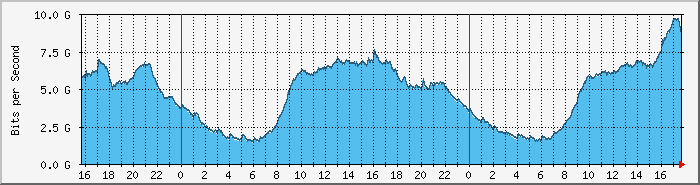
The picture below shows a snapshot of traffic over the London Access Point (LONAP) exchange.

lonap-total-day

It looks to me  from the right hand peak as if traffic has risen almost 50% over the same time yesterday. This compares with around 24% increase seen by Timico during the Olympics (see post). Fortunately Timico has the capacity to cope.

If you want to follow realtime traffic across LONAP you can check it out here.

Categories
Business social networking

Breakfast With Jeff Pulver In London

Next week I will be attending a Social Networking Breakfast organised by Jeff Pulver in London. For those of you that don’t know him Jeff was one of the pioneers of VoIP and ran the Voice On The Net conferences (VON).  VoIP is mainstream these days and Jeff has shifted his focus to Social Networking. 

Being a user of sites such as Facebook and Twitter I am a strong believer that the structures underlying what might be called the whole “social networking phenomenom” will server the business world well.  This is why I am attending the breakfast. I want to understand how best to use these tools to further my business interests.

This is despite the “not for business use” stance of Facebook. The interesting thing for me is that you can use Facebook to build relationships and get a message across without having to sell. In fact one of the things I like about Facebook is that I don’t feel I am being sold to. I don’t mind the notionally well targeted ads (I keep getting pitched singles dating agency ads though which as far as I know is not good targeting 🙂 ).

I am quite happy to mix personal friends, customers, suppliers and business colleagues as friends on Facebook. After all people do business with people.

As for next week this is an open event. It is being held at the Institute Of Contemporary Arts, 12 Carlton Terrace, London between 9am and 12 midday. Jeff would I’m sure appreciate advance notice of attendance and you can register your interest at this Facebook Event Notification.

For those of you who can’t go don’t worry. I’ll report back although it won’t be the same as being there.

PS I first met Jeff at one of his VoIP industry Executive Summits at Cannes in theSouth of France.  It must have been around 1998/99 and was my first foray into VoIP for my then employer. I recall sitting down for three days just writing page after page of acronyms for decoding later. I don’t anticipate the same problem next week.

Jeff Pulver
Jeff Pulver
Categories
Engineer internet

Wi-Spy for troubleshooting Wireless LAN

Wi-Spy is an impressive gadget used by our Tech Support team when they troubleshoot a customer’s network. Wireless Local Area Networks are often to blame if someone is experiencing slow internet access. Hotspots operate as a hub which means they can easily get congested if they have too many users.

It is easy for a corporate WLAN  to get ” bunged up” . Not only do you have to be careful how you implement your wireless Access Points but there are many other devices and technologies that use the same frequencies that can be a source of noise. Bluetooth handsets and microwave ovens are classic culprits.

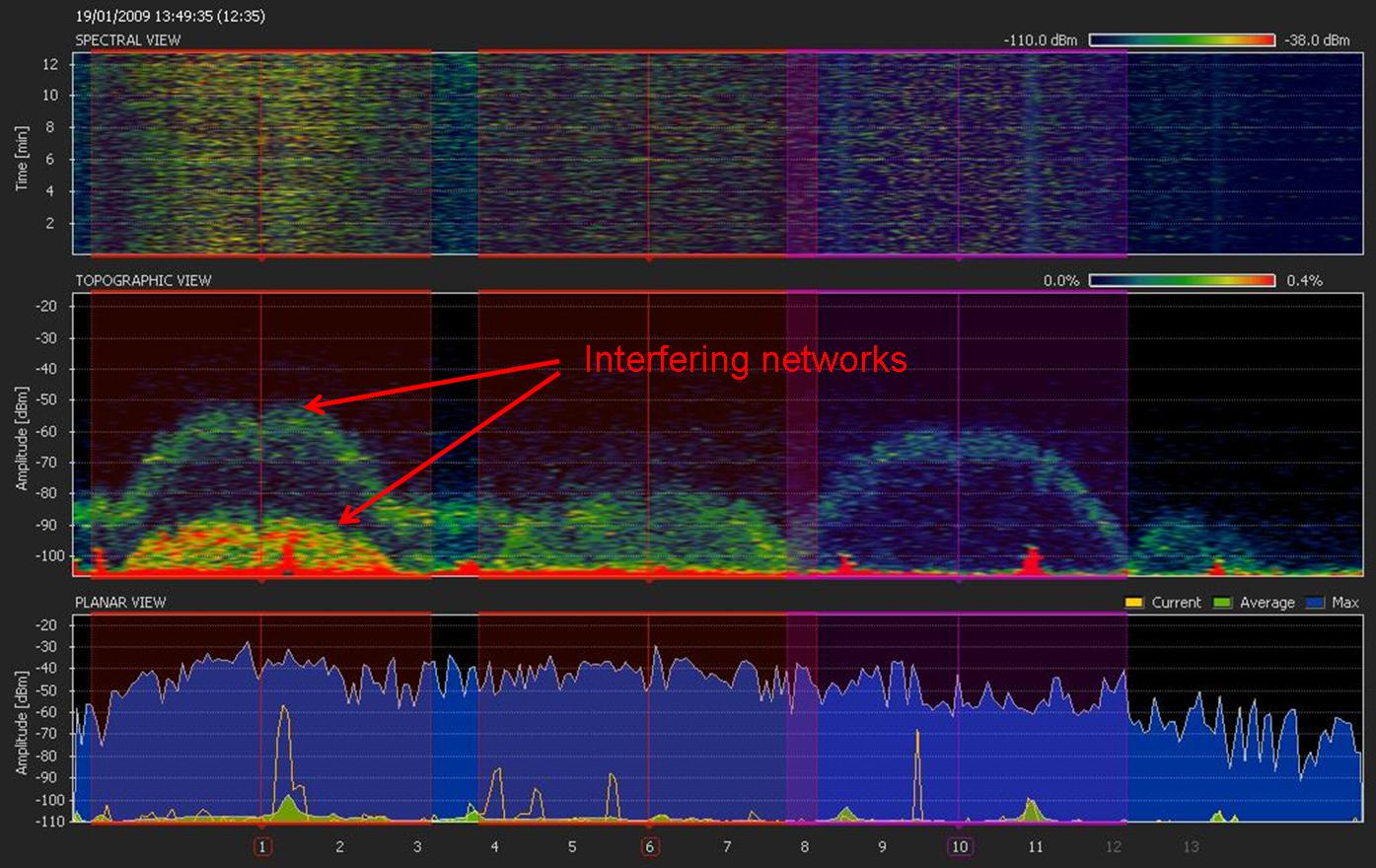
The picture below shows the profile of a customer’s WLAN when analysed using Wi-Spy. Each “bubble” on the middle  row represents a separate WLAN Access Point. It is easily possible to spot sources of interference. In this particular case we found two WLAN Access Points using the same channel, in this case channel 1 though you can’t see that from the picture.

What Wi-Spy was able to do for us is to lead us to the overlapping hotspots so that we could identify the cause of the problem and rectify it.

wispy

Although this blog does not set out to advertise any specific vendor or product I am more than happy to provide credit where it is due and in this case endorse it’s manufacturers Metageek.

Quick tutorial – a hub shares its bandwidth between all users. This means that traffic coming from one PC and bound for a specific destination such as the internet can bump into, or “collide” with traffic from other PCs on the same network. This slows a network down because the traffic, having bumped into other traffic, has to be resent.

This contrasts with the average wired LAN which is switched – a switch does not share its bandwidth between users. Users each get the full amount available and do not usually see the same congestion unless they themselves are trying to send more data across a network than the network can support.

Categories
Engineer engineering

CCNA Bootcamp

A good way to finish the week. I discussed the importance of training last week. Well this week the lucky members of the team did the CCNA Bootcamp training provided by Global Knowledge. I have to say the quality of the training was top notch and we couldn’t have asked for a better tutor in Brad Bradeepan. 

It wasn’t an easy ride. We are talking 8.30 am to around 7pm most days with studying to do back in their rooms afterwards and only 30 minutes break for lunch. Today, Friday they finished at 4pm. I’m a generous boss 🙂 .

I was impressed with the amount of information that they had to cover in the week. There was also a lot of subnet theory that had to be worked out manually. In the real world nowadays this is done by machines but it is a good discipline to have to properly understand the basics of networking. The Cisco CCNA, although it is the first step on the Cisco networking ladder, is not intended to be an easy qualification to achieve.

The exams now have to be taken before 14th February and there will be a lot of revision, and indeed hands on practice, to be done between now and then. We have a lab set up in each Timico Group location to help with this.

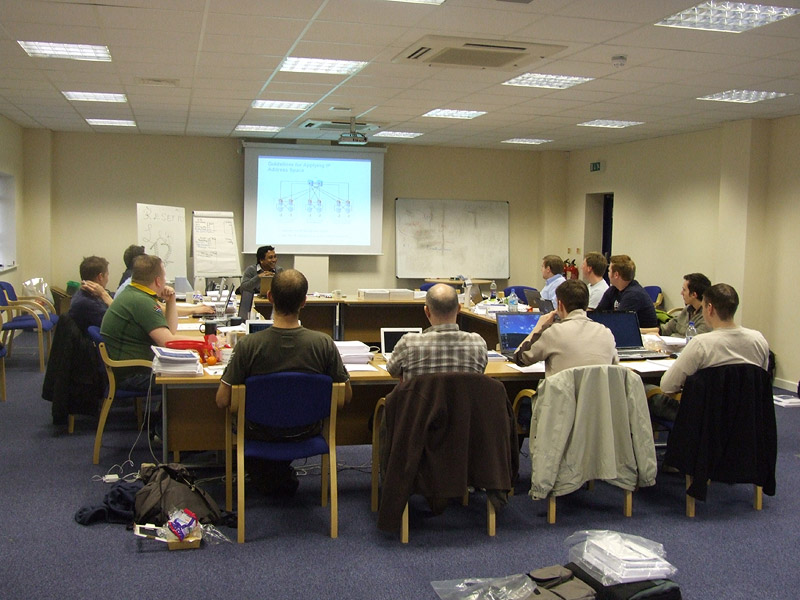
Photo below is the team with trainer Brad in the middle and me to his right.

group

This next photo shows them hard at work.

training

Categories
Business internet

Internet Service Provider Tax?

Just coincidentally following yesterday’s post on the BERR press release concerning P2P regulation today the Financial Times is saying that the Government is going to establish a “Rights Agency” to coordinate the enforcement of action against ISP customers breaking the law in respect of illegal downloading.

This agency will be paid for by a tax on both ISPs and the music industry. Strikes me that this is yet more burden on an industry that is already facing growing costs. I should sensibly refrain from further comment until we see an announcement.

I will however reiterate that I believe the right way ahead is is by mutual agreement between ISPs and the music industry together with end user education and the development of easy to access lawful distribution channels. In any event whatever proposals emerge there should be no implementation of any legislation without a full consultation process.

Categories
Business internet

Anti-P2P Piracy Regulation Likely To Be Imposed On ISPs?

The UK Government has stirred up the industry today with a press release by the Department of Business, Enterprise And Regulatory Reform (BERR) that intimates it’s intention to regulate ISPs into assisting the music industry to combat illegal downloading.

BERR is saying that last year’s consultation with stakeholders (ISPs and music industry) showed that there is no consensus on how to address the problem and the suggestion is that it sees regulation as being necessary. The whole subject matter, however, is riddled with complexity.

In 2008 the music industry, under a new representative body known as UK Music, run by former pop star  Feargal Sharkey, began discussions with what are known as the “Big Six” ISPs. These are the large branded ISPs that actually represent the majority of the consumer broadband customers in the UK. These discussions were held in private and the rest of the industry has not been party to what was actually being said. My understanding is that the discussions centred purely around enforcement and have not gone particularly well.

The problems centre around being able to prove who is doing the downloading and what is being downloaded – most ISPs can’t tell and have no interest – this surely is a privacy issue. Then there are the costs of policing and finally the fact that none of the ISPs want to lose customers.

At the ISP Conference in London last November I sat on a panel with Feargal Sharkey to discuss this whole issue. At that time we arranged to meet again in the New Year so that the other , smaller, UK ISPs, represented by the ISP Association of which I am a council member could participate in the discussion. That meeting is scheduled for 9th February. So the position taken by BERR is in my view somewhat premature as discussions between stakeholders do not yet appear to me to have  finished.

The nature of talks now is centred around licensing and revenue models. There have been some high profile announcements recently where some big consumer ISPs have severed their contractual relationships with music content providers. This is being done because the existing business models do not work. For example music streaming is licensed on a per stream basis. As the number of streams grow ISPs have to increase their capacity to measure and account for them and the cost of doing so soon outweighs the income derived from selling access to the music. 

So they have to look for an alternative. The strong rumour is that a big UK ISP has already negotiated a deal whereby it can sell unlimited access to music for a fixed monthly fee per subscriber (word on the street is that this is  BT though there has been no offical acknowledgement of this fact).

The meeting on the 9th February is likely to centre around how other ISPs can adopt the same model to everyone’s mutual benefit. From the ISP industry perspective it makes more sense to make music easy to access legally than to drag everyone into complex legal processes which will only benefit lawyers in the long run.

BERR is also now saying that this subject area is also now going to be taken under the wing of the Digital Britain Review, the interim report for which is due out at the end of this month. I am not convinced that this interim report will show much progress. The likelihood is that another consultation will happen in the summer with a target date for legislation in the autumn.

This timetable, I believe, does not really provide enough time for sensible consideration of the legislation and if I were the Government would not want to be getting into an unpopular debate with industry in the run up to the election. There is a feeling on the ISP streets that the government is now looking to come up with some good news stories to take them through 2009 and into a notional spring General Election in 2010.

Time will tell, and soon enough. I will continue to report and comment on this subject. This post is a little longer than usual but there is a lot to talk about.

Categories
Engineer virtualisation

Virtual Machines for Email Platform

We have stepped up our use of Virtual Machines at network level at Timico and recently rolled out a significant number of Xen based platforms. Xen (see Xen.org).  For those that don’t know a Virtual Machine is a virtual server that can run on multiple hardware devices simultaneously but can be seen as a single entity by the network. 

Because the company has been growing the need to scale up easily has become more and more pressing. Over the Christmas break (the Network Operations team is allowed two hours off for Christmas lunch which they take communally in the kitchen at the NOC 🙂 ) a new email platform was rolled out on Xen based hardware. As the burden of mail inevitably grows all Timico will have to do is add new hardware capacity with no need for network downtime or reengineering.

The beauty of Xen is that it takes very little time to add capacity to a server farm and downtime is minimal or non existent. You can therefore move a service from a small machine to a more powerful one with perhaps as little as 60 milliseconds interruption. 

All new servers are rolled out with Xen now at Timico. Whilst Xen is open source  and therefore free Citrix does sell a commercial version. If you have no skills in this space it could be an option but otherwise drop me a line if you want any advice on the subject.

Categories
Business media

BBC Radio appearance – audio

Wav file of my chat on the BBC re the Data Protection Act, Monday 12th January at 18.30 hrs.

monday-tech (8.65MB)

Courtesy of William Wright, BBC Radio Lincolnshire.

Categories
Business voip

Nortel Has Filed For Chapter 11 – Bankruptcy Protection

The hot news this afternoon is that Nortel has filed for Chapter 11 bankruptcy protection in the USA. This, as I recall, gives them a year to restructure their business under protection of the US Government without having to “worry” about action from creditors. There were  noises on the airways for some weeks regarding the company taking advice over Chapter 11. It goes to show there is no smoke without fire.

Nortel’s asset levels of around $1Bn are dwarfed by their liabilities of $12Bn. With debt due for repayment in 2011 they will have found it difficult to reschedule this debt under current market conditions. I understand that $107M was due tomorrow.

Speaking to staff at Nortel the whole company is affected and an interim “committee” has been appointed as an adviser to the board.

The biggest problem the company was facing, aside from the repayment of debt, was the funding of R&D moving forward. In particular in the enterprise and carrier VoIP space. The Metro Ethernet business, where Nortel is market leader but which is no longer core to their future VoIP plans, has been for sale for some time in order to provide working capital to fund R&D. I understand that some (unspecified) bits have been sold but a further announcement regarding this will be due in a couple of days.

Life is never boring. Nortel expects to come out of Chapter 11 as a new debt free entity. The brand is strong and the company itself is one of the oldest in the telephony business, if not the oldest. I can’t see it disappearing.

Bloomberg’s comment on the news is here.

Categories
Business ofcom voip

LLU Lines On The Up

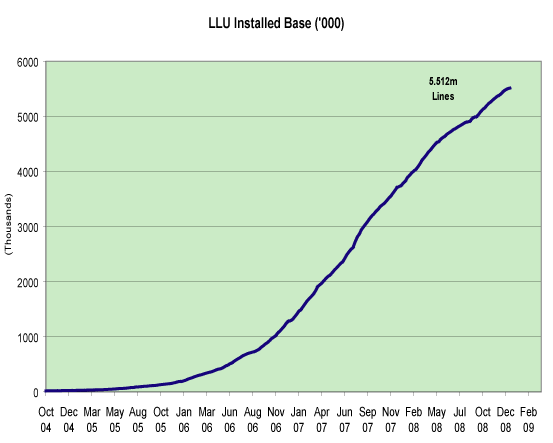
LLU, or Local Loop Unbundling continues to grow in the UK. The Office of the Telecommunications Adjudicator (OTA otherwise it’s a bit of a mouthful) has released it’s latest numbers which are for December.

llu-installed-base-dec08

It’s quite interesting to look at the curve. Can we see a classic product lifecycle curve here? Low initial growth then a steep incline followed by a tailing off that at this stage is barely perceptible. What concerns me somewhat is that I’m not sure that we should see a lifecycle curve for this product. It is a long term commodity play.

Also if you look at the Ofcom data for fixed line market penetration you can see that there is a long way to go before LLU should flatten out. It also means there is a long way to go before any other player’s market share is comparable to that of BT.

uk-fixed-lines

What is also interesting is that the fixed line market has stopped declining in terms of lines and indeed showed a small growth in 2007. We have to wait some time yet for the 2008 results. At 33.7 million fixed lines represents around 16% market share/penetration for LLU.

It would be interesting to understand why the number of fixed lines grew year on year. My guess is that it is the effect of more and more people working from home with companies paying for second analogue lines to carry a dedicated business broadband connection.

Categories
Business internet

Trefor.net live on the BBC

For anyone interested in listening in I am appearing on BBC Radio Lincolnshire at 18.30 hours today (Greenwich Mean Time). I am talking about the Data Retention Act which hit the BBC headlines on Friday and which has now been the subject of a couple of posts here and here.

This is not my first appearance on Radio Lincolnshire. However the last one was so long ago I think it was before CDs were invented and I was still playing with the Sinclair Spectrum Computer.

You can catch it on the internet on the BBC’s website at  http://www.bbc.co.uk/lincolnshire/.  I’m on “Drive Time with William Wright”. I’d be interested in any constructive feedback.

Categories
Business mobile connectivity security

Blackberry gets huge endorsment by Barack Obama

In the news is the fact that US President-elect Barack Obama wants to keep his Blackberry when he becomes president. This must be worth a fortune in advertising to Blackberry manufacturer RIM and indeed their share price seems to have risen quite healthily this week.

The secret service is of course concerned about the Presidential  email security and I will happily leave it to both parties to argue it out. What is of interest is why the Blackberry? Why not an alternative email device such as a PDA or Nokia Smartphone.

I used to have a Blackberry but moved onto Nokia, primarily because the Nokia E-Series had a SIP Stack that would allow me to play with VoIP on mobiles. The Nokia’s were more of a phone as well rather than a clunky data device.

The Blackberry has  moved on since then and a quick survey of the Tech Support team suggests that it now has the edge in terms of features and ease of use. There is now even  a Facebook plug-in for blackberry.

Certainly from a commercial perspective the mobile operators are doing a very good job at incentivising service providers to sell Blackberry as opposed to alternative mobile email solutions. 

What is really exciting is the pace of development in the mobile handset world. Competition is really working here driving features up and pricing down.

RIM 5 day stock performance courtesy of Yahoo Finance
Categories
Business internet security

Data Retention Act On The BBC News

I woke up this morning to an article on BBC Radio 4 concerning the forthcoming Data Retention Act (see previous post on this). The article was then carried several times on BBC Radio Lincolnshire, my local station – I’m sure it would have been repeated in all the regions.

The BBC’s slant concerned human rights and seemed to have been triggered by Human rights organisation “Liberty”. What has been happening since my post on the subject is that the tone of the Government’s conversation has moved on towards looking for a centralised database containing records of many different types of communications and not just email and telephony. This might include SMS, IM etc.

Nothing is set in stone here but I have concerns on two fronts. Firstly the technical cost and impracticality of implementing such a database would be huge and criminals would always be able to find ways around appearing on the records. Secondly is very much the human rights angle. 2008 saw a number of high profile examples of the loss personal data of millions of people because of stolen laptops and lost memory sticks.

I want to help the authorities catch criminals and haven’t really been too concerned in the past about their keeping my own personal records on file because I am a good boy. However in the light of last year’s data losses and because it is fundamentally not possible to totally trust the government (which is one of the reasons that democracies have elections) I have changed my tune.

If you want to read the BBC article online you can find it here.

Categories
broadband Business internet ofcom

Ofcom Publishes Research on Broadband Speed

Ofcom has just announced the results of its research into consumer broadband speed in the UK. The report says that 93% of UK consumers are satisfied with their general broadband experience although levels of disatisfaction do vary depending on where they live.

Rural users are, unsurprisingly less satisfied than urban users. Also the satisfaction ratings drop to 67%  for those people watching online TV. This is a warning shot across the bows for UK ISPs as using ADSL for watching TV online is going to see a huge growth.

Ofcom used broadband monitoring company samknows to conduct the research which also found that the average UK consumer ADSL speed was 3.6Mbps which is only 45% of the typically adverstised speed of 8Mbps. This is lower than the theoretical average max possible speed across the UK of 4.3Mbps taking different distances from the exchange into account.

The testing seems to have been quite comprehensive with 1500 homes involved running 7,000 different tests, meaning that over 10 millions tests were conducted overall on a range of supplier services. Interestingly the peak usage was found to be between 5pm and 6pm on a Sunday afternoon. I guess everyone is watching Songs of Praise online – assuming they still broadcast it 🙂 .

What would be interesting is if Ofcom were to commission the same testing for business broadband connections. Unfortunately this is unlikely to happen because the original research was conducted as a result of a perceived level of consumer disatisfaction that is not there where businesses are concerned. Although businesses use the same fundamental ADSL technology they typically run with ISP networks such as Timico that are less congested.

Categories
broadband Business

Shareband Bonded ADSL Broadband in Lincolnshire

It’s quite pleasing to see that since I last posted on Shareband bonded ADSL the proposition seems be gaining traction. Lincolnshire County Council broadband initiative “OnLincolnshire ” has placed a contract with Timico and is promoting the technology into the business community in the mostly rural county.

LCCs concern is that businesses in Lincolnshire have a level playing field with those in more urban areas of the country and to this end are not only trialing the technology but also will likely be using the results  to build case studies to attract business users. Great.

I have to say that my experience of working with LCC is that they are a very forward thinking organisation. As a long time resident of Lincoln it is nice to be able to work locally. Time was I had to get on a plane to meet customers.

The beauty for businesses in Lincolnshire is that along with the work that the Council is doing on connectivity comes EC funded grants to help pay for it. Living in a rural backwater suddenly becomes economically attractive as well as offering a high quality of life.