This website is using a security service to protect itself from online attacks. The action you just performed triggered the security solution. There are several actions that could trigger this block including submitting a certain word or phrase, a SQL command or malformed data.
What can I do to resolve this?
You can email the site owner to let them know you were blocked. Please include what you were doing when this page came up and the Cloudflare Ray ID found at the bottom of this page.
Another domain name scam email came in overnight. I’m told that a number of customers have had similar ones in recent weeks. My advice is to ignore these emails unless you have business aspirations in the Far East in which case you will probably already have your domain registered. I’ve reproduced the email here because it is mildly amusing to those of us who have not yet fully grown up.
Dear Manager,
We received a formal application from a person who is called Jacques Tits is applying to register “timico” as their domain names and Internet brand in Hong Kong and also in Asia on 2009-02-27. During our auditing procedure we find out that the alleged Jacques Tits has no trade mark,brand nor patent even similar to that word.As authorized anti-cybersquatting organization we hereby suspect the alleged Jacques Tits to be a domain or trademark grabber.Hence we need you confirmation for two things.First of all,whether this alleged Jacques Tits is your business partner or distributor in Asia.Secondly,whether you are interested in registering these domains and Internet brand instead of that alleged person.(The alleged Jacques Tits will be entitled to obtain a domain not needed by original trademark owner.)
If you are not in charge of this please forward this email to appropriate dept.
This is a letter for confirmation.If the mentioned third party is your business partner or distributor in Asia,please DO NOT reply.We will automatically confirm application from your business partner after this audit procedure.
I think I might have mentioned my appearances on BBC radio 🙂 . Well now I’m producing a video. Actually the video is being made by some final year students from Lincoln University media department and it is part of a series of shorts that the students are producing for Timico.
We are quite lucky to have a top level media facility such as Lincoln University on our doorstep. Their studios are the envy of the BBC- I kid you not.
To date any video I or anyone else at Timico has produced has been pretty much an experimental amateur affair. Now we are doing it properly. Each video has a production team of 4 people. I just need to get a Director’s chair with my name on it and turn up at the right time for makeup. Of course I’m sure I’ll have a script to learn as well!
Timico is a sponsor of Lincoln University and I am not only looking forward to seeing the videos but presenting a prize at the end of the year. I’ll also show the vids when they are finished sometime in the spring.
Google themselves use Gmail, so someone certainly noticed that the service was down.
Gmail email was down yesterday, you may have noticed. Certainly you might if you were one of their 113m strong userbase although I imagine that most are consumers and because it happened in business time it may not have had that significant an impact.
The service fell over because one of Google’s European datacentres failed which in turn had a knock on effect on some of their other datacentres. I have recently been visiting datacentres with a view to planning our next phase of expansion. Datacentres are rated in Tiers from 1 to 4, 4 being the most secure reliable and therefore most expensive.
In a Tier 4 datacentre you will find the ultimate in security mechanisms, biometric security, weighing machines etc. You also find the highest levels of resilience to power and connectivity failure. I was interested to learn recently though that there is a sensible limit to how much it is worth spending on a data centre as even Tier 4’s have been shown by modelling that they are vulnerable to catastrophic chain reaction failures .
I don’t know what Tier datacentres are operated by Google but they do employ someone specifically to manage reliability of their site. It just goes to show that when software and computers are concerned there is no such things as a 100% reliability.
In this case if you are totally reliant on a single email system it seems that there will always be a potential reliability issue. What you can do is have a totally separate mail system coming from a separate platform. I use both timico.co.uk from an Exchange server and trefor.net from our ISP platform.
Although I don’t ever recall the ISP mail platform letting me down certainly the Microsoft product has occasionally given me cause to resort to the backup. With a backup you can always call someone and ask them to resend to the other mail address and also use it yourself to send.
Most people have a personal email address but you might not want to give that out to a business acquaintance and in any event this type of email typically has file size storage and download restrictions. I’m sure others will have views on this subject but that’s my five pence worth.
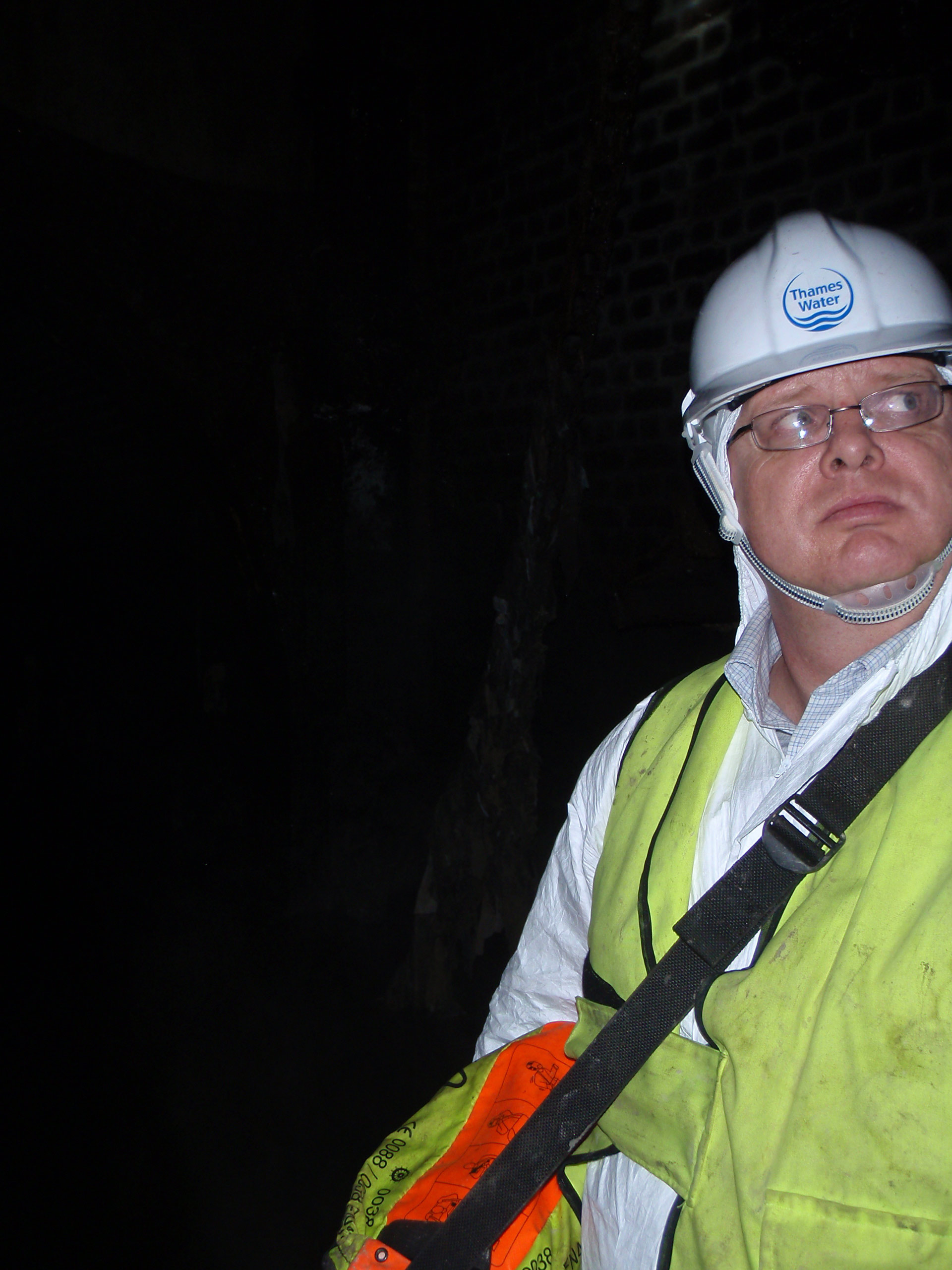
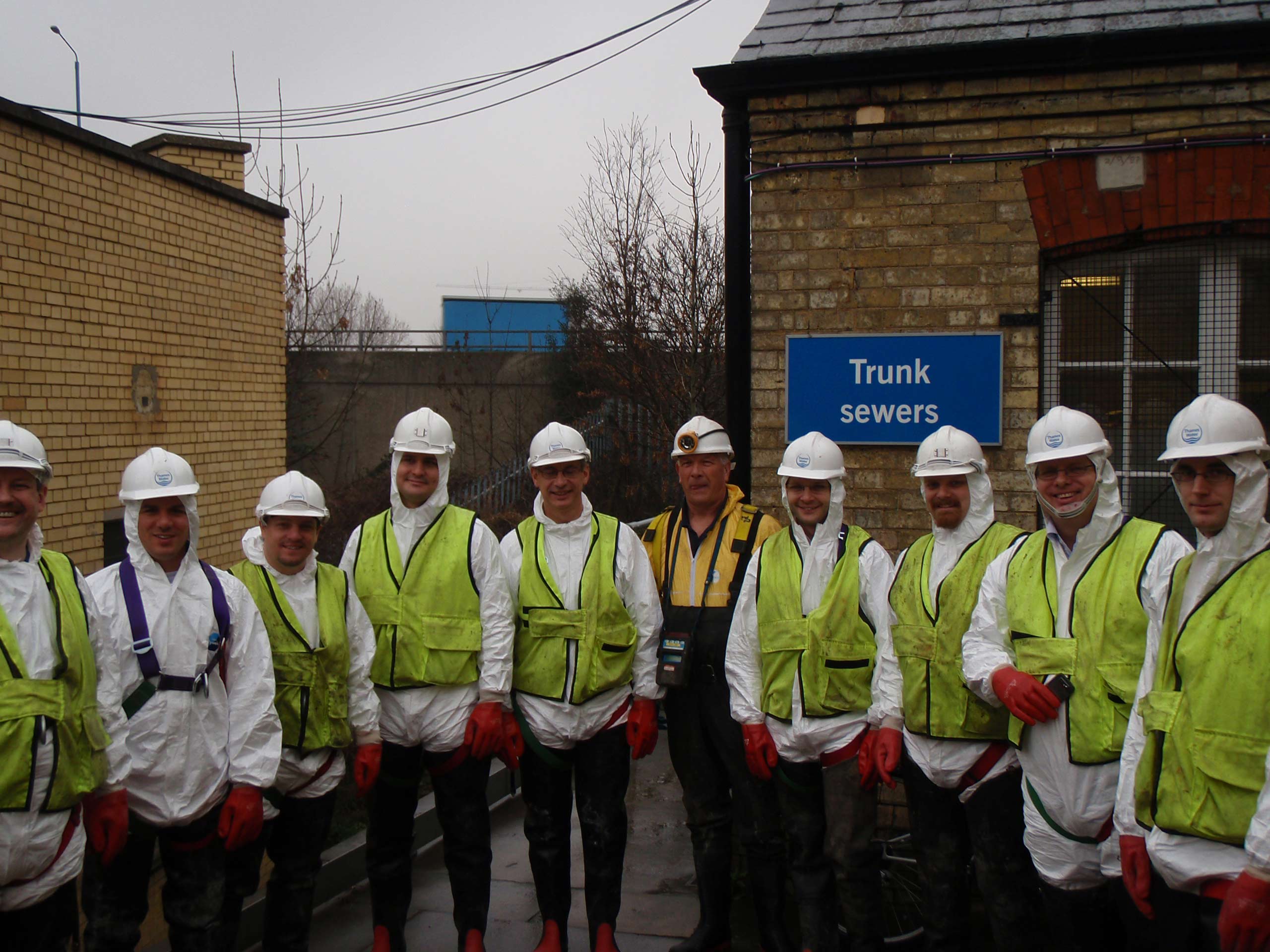
The things I have to do for the business. Today it was almost like being in a James Bond movie. I turned up at 10am prompt at the Thames Water Utilities Depot in Bow in East London – just around the corner from the site of the Olympic stadium which incidentally seems to be shooting up. I was met by Calypso Harland, bubbly marketing manager of Geo, the Alchemy owned business that sprang out of 186k’s UK fibre optic network.
I had been invited to inspect Geo’s London fibre ring which, yes you’ve guessed it, runs through the sewers. Donning layers of protective clothing I disappeared into a subterranean world for a once in a lifetime experience. Believe you me I doubt that anyone wants to do it twice.
The 140 year old Victorian sewers under London are I suppose of cursory interest. The message actually was that Geo can provide very cost effective and very secure fibre backbone connectivity because they use the sewers and don’t therefore have to dig up the roads.
What is interesting is the huge capacity there is down there. Geo run 4 ducts, three of which are currently empty. A duct can hold two fibre cables each with 288 strands of fibre. Each fibre can, using current DWDM technology, run 160 10Gbps channels (x 4 if you use phase modulation per wavelength).
So by my sums the Geo London ring should be able to operate at nearly 15 Petabits per second or roughly a billion times faster than the latest and greatest 21CN ADSL2+ connection. That’s a heck of a lot of capacity.
And for anyone that wants to know no, my thigh length wellies did not leak and no there were no floaters in sight – something to do with a high fibre diet apparently! 🙂
These sewers run on the surface (covered up obviously) right through the Olympic site. Come 2012 they will likely be crawling with security guards!
The average punter knows very little about e-crime. I can’t say I’m an expert myself but I had an eye-opening afternoon yesterday at the ISPA Parliamentary Advisory Forum on the subject. Attended by both MPs and industry stakeholders the meeting was standing room only which perhaps underlines the level of interest in the subject.
We use anti virus software in the belief that it stops nasty people putting nasty things on our PCs that will destroy our files. In the early days of e-crime this is what it was all about. Nerds sat in their bedrooms writing viruses with no real objective other than showing the world how big and powerful they were.
From around 2003 all this changed and e-crime became big business and the sad teenagers in bedrooms have turned into professional software writers working for organized gangs.
Now the crooks don’t want to break your computer. In fact they don’t even want you to know they are there. The malware that they deposit on your PC just sits there quietly logging your every keystroke. When you make purchases online your credit card information is logged and fed back to the gangs. The Conficker A virus even made your network run more efficiently so that it could better perform its job.
Until last year, when they were stopped, there were websites such as “darkmarket.com” (Google it for more info) where criminals talked to criminals, swapped trade secrets and engaged in crooked business such as the sale of stolen bank account information.
This criminal activity is organized primarily from the former Soviet Union, China and Brazil. The crooks know how to work the system. They never steal information from their own country. That way if a local police force is asked to assist with an international crime there is less incentive.
The police in Sao Paulo, for example have to deal with a high murder rate on the streets. How do you prioritise credit card fraud overseas in that case when you have limited resources to address problems on your own doorstep.
An Ukranian gang was said to stop the process of infecting a PC if it’s IP address was found to be Ukranian specifically to avoid the attentions of the local rozzers.
So what is being done in the UK to try and combat e-crime? It ain’t easy. Detective Superintendent Charlie McMurdie, who incidentally looked as if she was straight out of an action cop movie, runs the 30 strong e-crime unit at the Metropolitan Police and was speaking at the meeting.
With a team of only 30 people the police have to concentrate on big crimes. If someone rips off £50 from your credit card or bank account they aren’t interested. You are supposed to report it to the banks who then submit a collated picture to the police. In reality much of this type of crime goes unreported so nobody really knows how much of it is going on.
Where the police do get involved is with serial crimes. In other words whilst if someone pinches £50 from your e-wallet they aren’t interested, if someone does it to a thousand people then they are and this has happened in the UK.
Unfortunately, for someone who gets caught the penalties for this type of crime are often very low, community service for example, so the disincentive isn’t there. What’s more e-crime is often zero touch. In other words if someone steals TV programming and sells it to a Russian online TV Channel then the only thing affected is a potential reduction to the revenue stream of the rights holder. The man on the street is unharmed. This makes it less interesting to the police and is why the likes of BSkyB employ former policemen, effectively as revenue protection officers.
It isn’t fair to say that nothing is being done in the UK to prevent e-crime but the whole subject area is a difficult one and merits not only more effort but also improved levels of international co-operation due to the cross border nature of the game. I am afraid this is going to be an uphill struggle.
The Digital Britain report dominates current debate in the UK internet related industry. Its aim is, broadly put, is to promote universal use of broadband and to stimulate the digital knowledge economy thus keeping the country competitive in the 21st century. Although facilitating the plumbing of this digital economy, the Government quite rightly leaves the innovation of new ideas for delivery down the pipes to industry.
New York based innovator Jeff Pulver was a prime mover during the pioneering years of the VoIP industry. He started the Voice On the Net conferences and was founder of the company that evolved into Vonage, the US based VoIP telco. Jeff has since moved his attention to helping to create the wave of the Social Networking technology revolution. Both areas of technology, whilst requiring an underlying network to support them, hinge on the development of new ideas and applications.
TD: What parallels can you see between what was happening in the early days of VoIP and today in Social Networking?
JP: Social Networking has been part of the human experience since there was documented human experience. My focus is on the evolution of social communications, something I call: SocComm and what happens next as the world shifts from a dial-tone generation to a presence based one.
Back in the early days of VoIP we had dialup and slow computers and limited quality for the voice experience but it did not hold back a generation of people who were hobbyists by night but technology explorers by day who experimented with the technology and understand the power of what it meant when voice could be an application and no longer be a utility service.
I believe the advent of the widespread availability of social networking platforms such as Facebook and twitter are going to have a more profound impact on the future of communications in the next 5 years ahead than what we have seen in the VoIP space in the past 15 years.
TD: Aside from the by know well known business models associated with advertising, where do you see the moneytization of Social Networking?
JP: I am not a fan of pushing business models into nascent industries. Business models are disruptive to innovation and should never be forced into an ecosystem. What we will see emerge is another example of how disruptive technologies change the face of business in ways that were obvious to some by blindsided by others.
I believe presence will be moneytized with the advent of social communication. Presence will emerge to be a 25 billion dollar business.
TD: The battle against regulation of VoIP in the USA has been a feature of your career activities over the past ten years. Is there a similar debate to be had in the space you are in now?
JP: The fight is about to begin. Any platform which attracts 175 million active users (and growing) will get the attention of the government. My challenge is to see this space remains regulation free for the foreseeable future. (Maybe this is the foreshadowing of a future unannounced statement from me. hint hint)
TD: The UK has traditionally been strong in the production and delivery of content such as music and TV and this is recognised as a strength that our Government wants to maintain. Do you see any signs of internet innovation coming out of the UK in other areas?
JP: There were other signs in the late 90s and the post dot-com bubble but at the moment there are not a lot of hi-tech UK companies on my personal radar. I would like to change that.
TD: Can you paint a picture of life in the new Socially Networked world
JP: It is world where people are more real, we know the identity of the people we are communication with and a world where each of us contribute daily to the social sculpture known as the Internet.
TD: Whilst initially slated as a consumer oriented technology, Social Networking has now been adopted by large corporations as a marketing tool. Do you have an example of where this has worked successfully?
JP: Just ask the CEO of Zappos – @Zappos on twitter. They did a billion dollars in sales in 2008 and they have just about their entire organization focused on social media and on twitter. The Blue Shirt Nation of BestBuy is another example. This is the case where BestBuy launched their own internal social network for 130,000 people. These enabling technologies can and will change the world.
TD: Thank you very much for your time Jeff. You have had a punishing travel schedule over the past few months promoting Social Networking and have now started to raise the bar with conferences such as SocCom. Please accept my best wishes for the success with this activity.
Thanks for the opportunity to be read today. If you would like to learn more about my activities, please visit my blog – http://jeffpulver.com/ and follow me on twitter – http://www.twitter.com/jeffpulver .
The Digital Britain report dominates current debate in the UK internet related industry. Its aim is, broadly put, is to promote universal use of broadband and to stimulate the digital knowledge economy thus keeping the country competitive in the 21st century. Although facilitating the plumbing of this digital economy, the Government quite rightly leaves the innovation of new ideas for delivery down the pipes to industry.
New York based innovator Jeff Pulver was a prime mover during the pioneering years of the VoIP industry. He started the Voice On the Net conferences and was founder of the company that evolved into Vonage, the US based VoIP telco. Jeff has since moved his attention to helping to create the wave of the Social Networking technology revolution. Both areas of technology, whilst requiring an underlying network to support them, hinge on the development of new ideas and applications.
TD: What parallels can you see between what was happening in the early days of VoIP and today in Social Networking?
JP: Social Networking has been part of the human experience since there was documented human experience. My focus is on the evolution of social communications, something I call: SocComm and what happens next as the world shifts from a dial-tone generation to a presence based one.
Back in the early days of VoIP we had dialup and slow computers and limited quality for the voice experience but it did not hold back a generation of people who were hobbyists by night but technology explorers by day who experimented with the technology and understand the power of what it meant when voice could be an application and no longer be a utility service.
I believe the advent of the widespread availability of social networking platforms such as Facebook and twitter are going to have a more profound impact on the future of communications in the next 5 years ahead than what we have seen in the VoIP space in the past 15 years.
TD: Aside from the by know well known business models associated with advertising, where do you see the moneytization of Social Networking?
JP: I am not a fan of pushing business models into nascent industries. Business models are disruptive to innovation and should never be forced into an ecosystem. What we will see emerge is another example of how disruptive technologies change the face of business in ways that were obvious to some by blindsided by others.
I believe presence will be moneytized with the advent of social communication. Presence will emerge to be a 25 billion dollar business.
TD: The battle against regulation of VoIP in the USA has been a feature of your career activities over the past ten years. Is there a similar debate to be had in the space you are in now?
JP: The fight is about to begin. Any platform which attracts 175 million active users (and growing) will get the attention of the government. My challenge is to see this space remains regulation free for the foreseeable future. (Maybe this is the foreshadowing of a future unannounced statement from me. hint hint)
TD: The UK has traditionally been strong in the production and delivery of content such as music and TV and this is recognised as a strength that our Government wants to maintain. Do you see any signs of internet innovation coming out of the UK in other areas?
JP: There were other signs in the late 90s and the post dot-com bubble but at the moment there are not a lot of hi-tech UK companies on my personal radar. I would like to change that.
TD: Can you paint a picture of life in the new Socially Networked world
JP: It is world where people are more real, we know the identity of the people we are communication with and a world where each of us contribute daily to the social sculpture known as the Internet.
TD: Whilst initially slated as a consumer oriented technology, Social Networking has now been adopted by large corporations as a marketing tool. Do you have an example of where this has worked successfully?
JP: Just ask the CEO of Zappos – @Zappos on twitter. They did a billion dollars in sales in 2008 and they have just about their entire organization focused on social media and on twitter. The Blue Shirt Nation of BestBuy is another example. This is the case where BestBuy launched their own internal social network for 130,000 people. These enabling technologies can and will change the world.
TD: Thank you very much for your time Jeff. You have had a punishing travel schedule over the past few months promoting Social Networking and have now started to raise the bar with conferences such as SocCom. Please accept my best wishes for the success with this activity.
Thanks for the opportunity to be read today. If you would like to learn more about my activities, please visit my blog – http://jeffpulver.com/ and follow me on twitter – http://www.twitter.com/jeffpulver .
Been a busy week again. Where do they all go? This week was a milestone for Trefor Davies in that I got my first 622Mbps BT central pipe. It’s not mine really of course, it is Timico’s but it feels like mine – toys for the boys 🙂 .
Not everyone will understand the significance. When an Internet Service Provider starts life they begin with a small connection to the BT (Wholesale) ADSL network. They use this connection, known as a “central pipe”, to carry broadband web traffic from their ADSL customers to the internet, email server, co-located equipment etc.
The ISP itself usually provides the applications (ie email) and contracts with a variety of network providers to offer resilient access to the internet.
As the number of broadband customers grows more BT central capacity needs to be added and this is normally done in affordable “chunks” rather than going straight for a big connection that would almost certainly be uneconomic for low levels of ADSL customers.
Unfortunately for the small ISP the bigger the connection the better the level of service experience that can be offered. This is particularly the case if an ISP has many small (34Mbps) pipes.
So this week Timico moved into the bigger league with a 622Mbps pipe and cancelled 7 smaller pipes. What is more our second 622Mbps pipe is due for delivery in April giving us a huge headroom in capacity/expansion capability. This is in additional to the resilient 1Gbps links we have for 21CN.
Ironically although supposed to provide 622Mbps these pipes in reality provide more bandwidth than advertised. This compares with a 155Mbps pipe which typically only provided 120Mbps capacity in two separate 60Mbps halves and a 34Mbps pipe which only provided 25Mbps capacity.
In the process of checking out our datacentre expansion options I have been meeting with a number of vendors. Today I met Verari Systems who manufacture high density blade based storage solutions and sell datacentres in a container. Yes that’s the same type of container you see hauled around on the back of trucks world-wide.
The beauty of containerised datacentres is the time to market. Four months from ordering you can be up and running with new capacity. You just need to supply the power and a secure place to put the container.
What impressed me was the quoted 11Petabytes of storage that Verari could achieve in a 100KWatt container designed to hold between 10 and 15 racks. This, for the mathematically challenged/lazy amongst us is in round terms the equivalent of eleven thousand Terrabyte PC hard drives.
Keeping the maths simple a rack can hold 42 servers (PCs) so ten racks would have the equivalent of 420 servers. The Veraris solution offers 26 x more density of storage than a PC. I have been buying Servers with 3Terrabytes of resilient storage – Verari still offeres 8 x the density.
I picked up the Conficker worm whilst at LINX64 yesterday. I’m pretty sure I was one of the few Microsoft users in the audience of out and out geeks so I know not whence it came.
My virus checker caught it, or at least told me it was there. This morning I gave my machine a complete set of security updates and it is now clean.
This is not an easy worm to remove. You can use a free tool provided by Symantec at this location. The Microsoft update that patches the vulnerability is at this location.
66% of the global routing table is carried by LINX. This means an Internet Service Provider can connect their customers to 66% of the webservers (is websites) in the world just by hooking up to LINX at their Docklands locations. Using Peering Exchanges like LINX allows us to cut down on expensive internet connections.
LINX has 57 of the world’s top 100 network operators as members, including 16 of the top 20. This confirms the not-for profit organisation as one of the world’s leading peering points.
In 2008 they had 13 membership cancellations of which 8 were consolidations. There are a further 6 consolidations in the pipeline. An indication of the ongoing rationalisation of the industry.
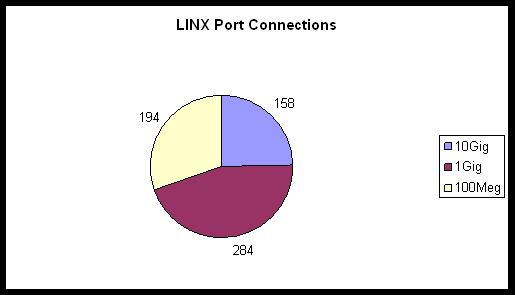
Finally I have put a pie chart together illustrating the distribution of ports at LINX in terms of 100Meg, Gig and 10Gig Ethernet. Not shown are stats that the 10Gig ports are on the rise and the 100Meg, perhaps unsurprisingly considering the rise in internet usage, in decline.
Dame Stella Rimington is in the news today attacking the government’s postition regarding data retention. This is in tune with comments previously made on this blog.
I sympathise with the need to guard against terrorism but you do get the feeling that we are moving backwards. When I was growing up we were hit with propaganda about the communist enemy. A police state where people were frequently spied upon just in case they had views that were contrary to official policy. Increased levels of surveillance in order to catch terrorists is undoubtedly going to impact on many innocent lives. If we are not careful we will end up mimicking the police states that we were cricisising not so long ago.
This post has nothing to do with IP. I reserve the right as a proud parent to promote the interests of my family. The media file below was recorded on Saturday by “White on White”, a guest band on my son Tom’s radio show Wake Up To The Weekend” on www.sirenonline.co.uk Saturday and Sunday mornings.
Datacentres are quite a hot topic in the Internet Service Provider world, and their costs are rising, largely due to the increasing costs of power and cooling.
In the UK the major datacentres have typically been located in London’s Docklands. This is because Docklands is where most of the world’s major network providers connect. The cost of connectivity has traditionally been far too high to locate critical network infrastructure outside the capital.
I am sat in the LINX meeting in London writing this post listening to Bob Harris, Technical Services Director of Telehouse, one of the major datacentre players in Europe. Timico is already located in Telehouse North and East. Well the news is that they are building a Telehouse West (not particularly new news).
What is interesting are the financials associated with this project.
£165m over 5 years (£80m over 1st 2 years for the first two floors)
5 floors with 985 sq metres per floor
425 racks per floor providing 4KW per rack = total 2125 racks
Business plan to fill the facility over 3 – 5 years
That works out roughly at £78,000 per rack or just under £20,000 per KW. In terms of contribution to the operating costs the capital depreciation is £258 over 25 years, which is incidentally a long time in this game – 10 years might be considered more normal and the period has been arbitrarily chosen by me for illustration. Remember this is before anyone starts charging for operating costs.
I think the costs of this project point towards a trend to start building datacentres outside of London. Communications costs have plummeted and service providers and businesses are going to start hosting all but their most critical, perhaps latency sensitive, infrastructure outside the M25.
You can follow the progress of the Telehouse West building on their webcam here. I’ve pasted a picture of a typical backup generator that is used by datacentres to give you a feel for where the costs are incurred.
PS I don’t think there is room for a Telehouse South, in case anyone was wondering.
The BBC today has reported that Italian crooks are using Skype to avoid detection by police who use traditional wiretapping to monitor phone calls. The Skype signaling and media path is encrypted which makes it very difficult to tap into. Also because, as a Peer to Peer protocol Skype doesn’t use any centralised servers that might be able to be monitored it adds to the difficulty for law enforcement agencies.
The whole problem is then compounded by the fact that because VoIP/Skype is a very nomadic service, ie you can use it from any internet connection anywhere, it becomes difficult to track the location of a caller.
This is a problem being looked at by Ofcom as part of the process of caller location identification for the emergency services. Currently if someone makes a 999 call from an unknown address, it is difficult to pin down where that call is being made from, at least in a timely manner.
There was a high profile Canadian case where someone dialled for an ambulance and it went to a location three thousand miles from where the call was actually being made from because the address held by the operator was not the address from which the call was being made.
When a VoIP call is made the details of the call logged by the Internet Telephony Service Provider include the IP address of the originating party. If you are an Internet Service Provider (note the distinction between ITSP and ISP – an ITSP often does not provide the underlying broadband service) you can correlate this IP address with a physical address (ie house number and street).
The problem is that this is a manual process and would likely take hours at best and potentially a couple of days. This is a process that could be automated but it is something that would probalby cost billons to implement universally in the UK.
I’m sure there will be more to say on this subject in 2009. As a final note it is often said that the security forces, aka GCHQ and CIA et al have not cracked the Skype encryption technology. I find this difficult to believe.
Timico is a member of LINX, or the London Internet Exchange. Linx is a not for profit meeting point in London where ISPs and network operators meet to peer their traffic, ie to share their connectivity with one another.
It is a sign of the pace of growth in internet related activity that membership of LINX rose in 2008 to 308, up by around 20% from the previous year. The peak traffic carried over the LINX network is over 400Gbps which is a lot of ADSL connections.
The LINX meetings are not only good networking opportunities but a great place to keep up with developments in internet technology. This week the subject matter includes at IPv6, DNS security and SPAM. LINX64 is sponsored by Telehouse.
RIM has announced its latest upgrade to the Blackberry Enterprise Server. BES5 notionally provides a number of improvements (one might reasonably expect! 🙂 ) but one in particular caught my eye.
A BES sits LAN side of a corporate network and access to it is via an encrypted 3DES (or higher) path. Being LAN side is allows useful access to a company’s intranet. However what it didn’t do, or at least not without the involvement of a third party application, was to give access to computers on that LAN. This meant that accessing data on corporate servers was not straightforward.
With BES5 you can also access attachments within calendars. This is very useful in my mind. I often store location information for meetings in my calendar but my Nokia E Series phones don’t provide me with access to any of the notes. At least if they do I can’t see how.
I am indebted to one of our Blackberry gurus Will Curtis for the BES update. He has his own mobile gadget oriented blog with a post on this subject if you want to know more.
One of our account managers told me in passing that a customer of his had just shut up shop. Bad news I thought. Is this going to be the way of it in 2009?
The good news though is that what they have actually done is closed the office and moved their 5 members of staff to work from home to conserve cash. Their VoIP subscriptions, which they were already using flexibly from both office and home, will just follow them.
Business is still there to be grasped when times are hard.
I see that Microsoft has offered a $250k reward for the arrest and conviction of the authors of the Conficker worm. This is the one that was causing Timico customers issues in the run up to and over the Christmas break.
I did suggest to one of our tech support guys that were he to admit to the offence the rest of us (who would have pocketed the cash) would be eternally grateful. Funnily enough he didn’t think it was a good idea.
I do get images though of a bounty hunter turning up at the Microsoft HQ in Seattle with a guilty looking nerd roped kicking on to the saddle of his horse.
I attended the ITSPA council meeting in London today. One of the topics of discussion was the content of the forthcoming ITSPA workshop in Town on 12th March (ask me for details if you don’t already have them).
We had it down as “opportunities and threats in the recession” or words to that effect. Not much detail. The debate then covered a range of subjects that might be suitable for the workshop ranging from whiz bang new video phones to just lower cost services.
What we came up with, and I think this is going to make for a highly interesting afternoon, was a debate on whether it was lower costs or new features that was going to make people buy our services and get the industry through the year or two ahead.
Personally I think it is both but I am looking forward to the debate. If anyone wants to come let me know. There is a dinner afterwards and these are normally great evenings.
The much heralded Data Retention regulations were published today. The Act is due to become law on 6th April and has caused consternation amongst privacy rights activists and initially amongst the Communication Provider Community.
The specifics are
4 —(1) It is the duty of a public communications provider to retain the communications data specified in the following provisions of the Schedule to these Regulations—
(a) Part 1 (fixed network telephony);
(b) Part 2 (mobile telephony);
(c) Part 3 (internet access, internet email or internet telephony).
Part 3 was the bit causing the fuss – the storage of email and web browsing habits. The CP community has somewhat calmed down since because further down in the spiel it says:
10-(1) These Regulations do not apply to a public communications provider unless the provider is given a notice in writing by the Secretary of State in accordance with this regulation.
The Government had previously said that it would only make the largest CPs comply and here they have essentially put it in writing.
Moreover:
11. —(1) The Secretary of State may reimburse any expenses incurred by a public communications provider in complying with the provisions of these Regulations.
So all in all, the privacy issues aside, it seems to have been a storm in a teacup for an industry that was worried about all the additional overhead that would be incurred in complying with the Act.
I note that the economic recovery package proposed in the USA includes between $6bn and $9bn to assist with the implementation of broadband in rural areas (The Register today). In the UK the Government is also talking about making the provision of universal access to broadband compulsory though I’m not sure whether they are going ot subsidise it.
What is worth noting is that the real debate in the UK is around how the country rolls out Next Generation Access which is fibre to the home and an order of magnitude up from broadband in terms of speed. This has been costed at £29bn.
There is a scenario where the UK could leave the USA behind in the internet infrastructure game. I imagine that the cost of implementing a NGA network in the USA will be an order of magnitude up again on the UK, just because of the sheer size of the country.
Unfortunatley (depending on your perspective) the USA is far better placed for the stimulus of innovation than the UK when it comes the applications to run over this infrastructure.
As 2009 evolves it is becoming much clearer where the world of Unified Communications is going. UC has always meant different things to different people. Yesterday I saw it move on with the Twitter coverage of SocComm.
What is now becoming obvious that we are moving to a world where everything interoperates with everything else. A bit of a generalisation and very dramatic I know but anyone expecting to be a player in communications markets in the future needs to have an open approach to doing business.
So vendors traditionally associated with fairly closed UC plays, such as Nortel, Cisco and Microsoft need to make it easy to integrate their tools with new kids on the block such as Facebook and Twitter. They are all moving towards this slowly. Timico is in the middle of a major platform upgrade with its Nortel UC capability and the new offering will optionally enable Instant Messaging with other networks such as MSN, jabber, yahoo etc.
It is only a short hop then to see Nortel soft clients embedded in Facebook (they already do this with traditional business tools such as Outlook and Lotus Notes), Facebook profiles and Twitter feeds embedded in corporate websites and vice versa and wall posts embedded wherever you care to embed them (plasma display on the fridge?!).
There was a time when I thought that the world of UC would be dominated by a few giant players. Now, we are seeing that new companies can easily develop applications that sit well with existing systems. 2009 is looking like a year of accelerated integration and I think that the phrase Unified Communications is already dead on it’s feet because I don’t think it adequately describes what is actually happening.
As 2009 evolves it is becoming much clearer where the world of Unified Communications is going. UC has always meant different things to different people. Yesterday I saw it move on with the Twitter coverage of SocComm.
What is now becoming obvious that we are moving to a world where everything interoperates with everything else. A bit of a generalisation and very dramatic I know but anyone expecting to be a player in communications markets in the future needs to have an open approach to doing business.
So vendors traditionally associated with fairly closed UC plays, such as Nortel, Cisco and Microsoft need to make it easy to integrate their tools with new kids on the block such as Facebook and Twitter. They are all moving towards this slowly. Timico is in the middle of a major platform upgrade with its Nortel UC capability and the new offering will optionally enable Instant Messaging with other networks such as MSN, jabber, yahoo etc.
It is only a short hop then to see Nortel soft clients embedded in Facebook (they already do this with traditional business tools such as Outlook and Lotus Notes), Facebook profiles and Twitter feeds embedded in corporate websites and vice versa and wall posts embedded wherever you care to embed them (plasma display on the fridge?!).
There was a time when I thought that the world of UC would be dominated by a few giant players. Now, we are seeing that new companies can easily develop applications that sit well with existing systems. 2009 is looking like a year of accelerated integration and I think that the phrase Unified Communications is already dead on it’s feet because I don’t think it adequately describes what is actually happening.
I already posted about SocComm which is happening in New York today. Well I just caught up with it via Twitter and I’ve been blown away with what I saw.
You can follow it at the SocComm web address http://www.soccomm.com/twitbuzz.html.
When I looked it was during the government and regulation session and the tweets all address this. The main concern I could see from the tweets was associated with what the US government might do in terms of regulating personal privacy issues and whether this might suppress development of Social Networking.
I was going to say Social Networking Technology but I hesitate to use “technology” because it seems to be much more than about the engine/platform that makes it all happen. It is more philosophical than that.
The information is coming in think and fast. It is really a speed read. Jeff Pulver told me he had 25 twitterers lined up in the audience but I can believe, undertanding the nature of the conference, that most of the audience is Twittering. The conference goes on all day New York time and if you miss it I imagine you will be able to catch up at a more leisurely pace .
PS it is too late I’m sure to invent another word for it but twitter is a bit irritating ! 🙂 .
PPS SocComm has just flashed up as the 3rd most active event on Twitter at this time
In some respects Timico is punching above its weight but our philosophy is to reach for the stars, which might be why we were 4th in the Sunday Times Techtrack last year.
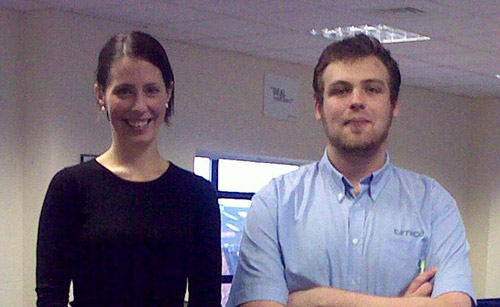
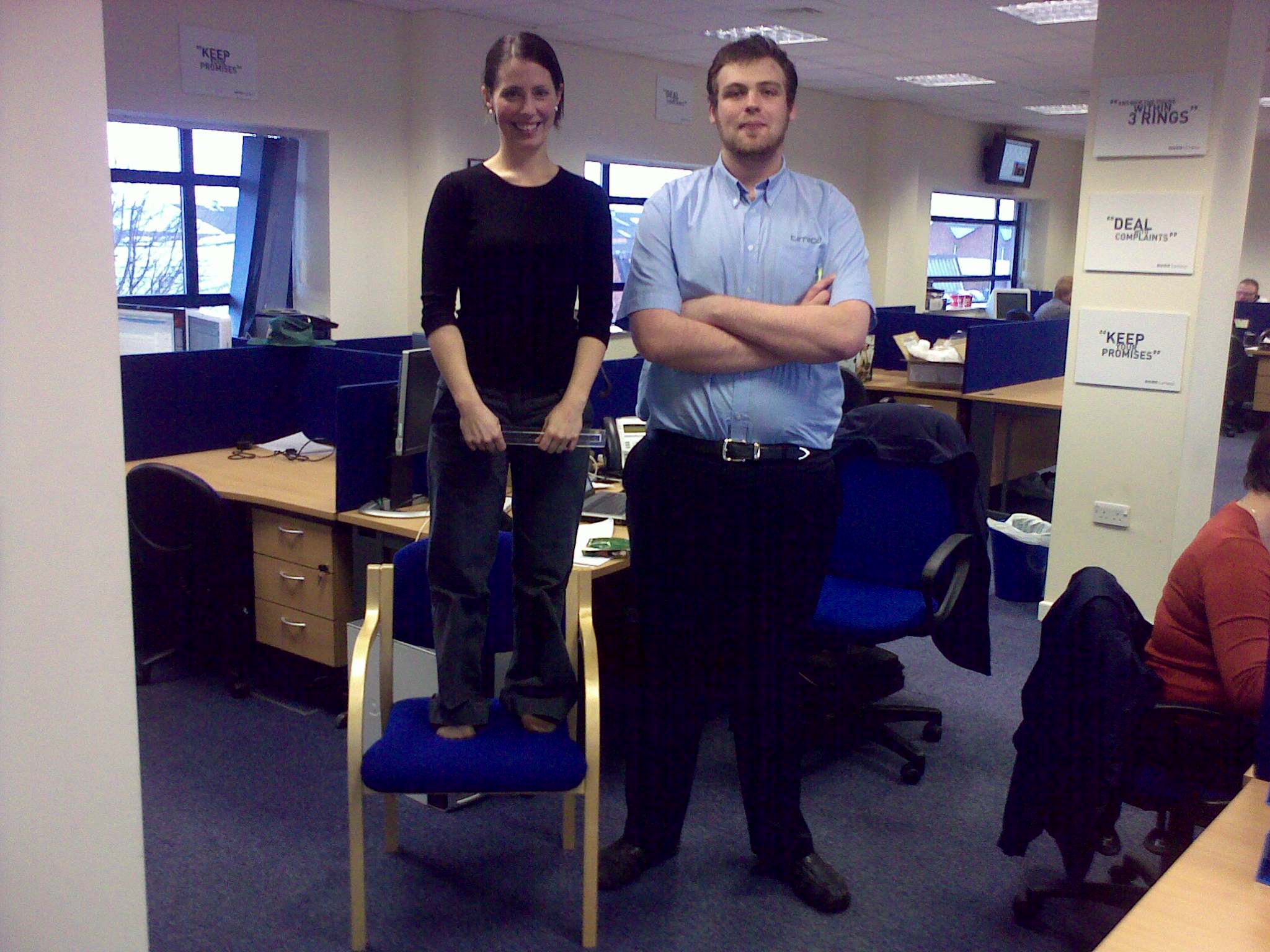
The long and the short of it a company is only as good as its people. Michelle Sharp is Director of Customer Services at Timico. Gareth Bryan is a Technical Solutions engineer and is often out and about on customer sites. Both are pictured below. You need to scroll down below the photo to appreciate that all is not what it seems.
Using the ruler (30 cms or 1 foot) in the photo as a reference there is a prize for guessing the size difference between the two. Bonus points for getting their actual heights right. (Timico staff need not apply 🙂 )
In some respects Timico is punching above its weight but our philosophy is to reach for the stars, which might be why we were 4th in the Sunday Times Techtrack last year.
The long and the short of it a company is only as good as its people. Michelle Sharp is Director of Customer Services at Timico. Gareth Bryan is a Technical Solutions engineer and is often out and about on customer sites. Both are pictured below. You need to scroll down below the photo to appreciate that all is not what it seems.
Using the ruler (30 cms or 1 foot) in the photo as a reference there is a prize for guessing the size difference between the two. Bonus points for getting their actual heights right. (Timico staff need not apply 🙂 )
At the board room of the Performing Rights Society in London today the great and the good of the UK Music industry met with representatives from the mainstream ISP community for an open discussion on how to handle illegal P2P music downloading.
Organisations represented included UK Music, BAC&S, PPL, PRS, MMF, MPA, MU, MCPS, MPG, Timico, ISPA, O2, Orange, AOL, Yahoo, BT, GlobalMix, LINX, Playlouder and KCom. I’m sure I’ve missed some out and you will have to work out for yourselves what some of the acronyms stand for.
I was essentially there on behalf of the Internet Service Providers’ Association to represent the smaller ISP community who have been left out of the talks up until now. Whilst the “big six” largest ISPs probably represent over 90% of the market the other ISPs, of which there are easily in excess of 300, do represent a “significant other”.
As much as anything the meeting was a “getting to know each others’ perspective” session but a few points in particular stuck in my mind.
We were not allowed to discuss commercial issues and there was a lawyer sat in the corner who interrupted whenever the conversation moved towards this area – the concern being that nobody wanted the meeting to be seen as price fixing. I understand that any initiatives up until now have failed because the Music Industry can’t agree on prices that will allow ISPs to make money out of offering legal music download services.
It was suggested by yours truly that to make the whole business model work there needed to be a wholesale provider that would make it easier for smaller businesses to participate. This wholesale provider would have sorted out the rats nest of copyright and licensing issues. Some larger ISPs had 5 corporate lawyers in a department exclusively dedicated to this area. What hope the rest of us!
There is clearly some way to go to get to a working solution although there was general agreement around the table that everybody wanted to help.
ISPs present were asked whether P2P traffic caused problems for them on their network. I stated that typically B2B ISPs did not throttle P2P traffic and customers were provided with a high quality experierience for which they paid a premium.
In the consumer space customers seem not prepared to pay for quality and thus in order to try and preserve a reasonable experience for “ordinary” applications such as browsing and email it is often standard practice for ISPs to throttle P2P traffic. In fact in fairness some ISPs publish these policies on their website. This touched a nerve with one Tier 1 ISP who avoided the word throttling using, instead, “traffic management” as a less contentious phrase.
Completely unscientific but as a rule of thumb there are typically 10% of my Facebook friends online at any given time. Except for early in the morning, anecdotally this stacks up with what others have said as well.
I am online for most of my waking hours though not necessarily always on Facebook. Assuming I am on 16 hours a day, which is a bit of a stretch but not wildly off the mark this suggests that my friends are typically on Facebook for around 1 1/2 hours a day.
I’m not always active when I am online, of course.
I’ve been conversing on Facebook with Jeff Pulver and am somewhat gutted that lack of time keeps me from attending his SocComm conference in New York this coming Tuesday, 10th February.
Jeff has a lot of experience in running such events and is confident that this one “will represent a defining moment” in Social Networking. His line up of topics is very interesting covering a range of areas such as regulatory, marketing, communications, mobility and investment.
What is also educational is the line up of sponsors, (ZiXi | Vivox | Phone.com | Pathable | Ripple6 ) fairly short this being the first time this show has been staged, but also an example of where people think there might be money to be made in this space.
I’m sure Jeff will be running other SocComm events and I look forward to the time I will be able to attend. In the meantime if anyone who is going wants to give me some feedback that would be great.
You can follow the event on Twitter at #sc09 and #soccomm. Jeff has a team of 25 twitterers lined up in the audience.