
Categories
End User internet

WolframAlpha

Having discussed the suitability of “bing” as a name for a search engine someone mentioned that they had recently found a site called WolframAlpha. Now that’s what I call a name.

WolframAlpha is a “computational knowledge engine”. It is worth a look. I suspect that it has a long way to go before matching google though.  I typed in a simple question: “how many IPv6 addresses are there”  and it didn’t know where to look.

Also it is fairly flawed in other ways. I typed in my birth date, December 9th, 1961 (it likes it the American way round) and whilst it did come up with some really useful statistics such as the fact that I have now been on this planet for 17,338 days it could only come up with some actor called Joe Lando as having been born on that day.  Huh!

Interestingly, site founder Stephen Wolfram went to Eton with our CFO Jonathan Radford. 

As a footnote to the bing post I have already seen some favourable comments on it on Facebook.  Time will tell.

Categories
End User internet

bing.com

I see that Microsoft has launched “bing” as its latest offering to compete with Google.  I checked and this isn’t April 1st so it must be true.  All I can say is it better be good at what it does because the name doesn’t exactly roll off the tongue and it will need real customer loyalty for people to go to the site.

Ping would have been hugely better but no chance of getting that domain name.  Microsoft will have spent millions researching the name!

I wonder whether bing is the Urdu word for white elephant?  I’ll check.

Categories
Archived Business

Market bellweather

Timico isn’t big enough (yet) to be a market bellweather.  However there is a feelgood factor about the place which I hope is replicated elsewhere in UKPLC – I fear this is not the case everywhere.

This morning we had our usual monthly board meeting followed by the Annual General Meeting, which as you might guess is annual and not monthly 🙂 .  This was attended by a good number of our investors.

Timico is lucky to have very friendly investors and I am pleased to say the feedback was hugely encouraging. Our shareholders are all friends and family but that doesn’t mean they aren’t financially sophisticated individuals. Pretty much all of them are successful businessmen and women. It’s great to be given a pat on the back and told that “you are all doing very well”.

I also learned a new word today.  Apparently I’m a technosnob.  I’m not quite sure what a technosnob is but I think I’m ok with it. If it means that we are only satified with being the best technically then I am definately ok with it. If it means we win lots of corporate managed networks business, which we are doing, then technosnob is the way to go.

Categories
Business media

Rural broadband on the BBC news this morning

The BBC has picked up a rural broadband news item this morning with another community rolling out fibre, this time with a 20Mbps broadband service, presumably with a bigger backhaul than the 2Mbps that serves Wennington and Wray (see posts from 2 weeks ago).

I suspect the media is building up for more coverage when the Digital Britain Report is released in mid June.  There seems to be some disagreement in Cumbria as to the efficacy of the investment already made in the area. Whether individual communities already get coverage or not is somewhat a moot point really.

I think the issue that is quickly going to overtake us is the adequacy of the  “up to 2Mbps” speed being bandied around as a target by Government as a Universal Service Obligation.  Many city dwellers already have access to 40 or 50Mbps and with BT’s Fibre To The Cabinet trials about to start this figure will become very much the standard to aim for, unless you live in a rural community that is.

Whilst BT CEO Ian Livingstone maintains that 2Mbps is good enough for most people’s uses, experience in the Far East, where high speed internet access isn the norm, have shown that people’s online behaviour does change as faster speeds become available. They are more likely, for example, to watch High Definition video online.

This is all going to add pressure to ISPs’ networks but I do believe that the UK is being shortsighted in not considering a ubiquitous Next Generation Access fibre network from the off.

Categories
Business online safety

CEOP ANNUAL REPORT PUBLISHED

There is nothing that engenders feeling of disgust and revulsion more than the thought of child sexual abuse. This week the The Child Exploitation and Online Protection Centre (CEOP) published its third annual report.

It is pleasing to read that CEOP has been increasingly successful with its work which is growing harder because of the proliferation of social networking websites that make it easier for adults to approach children online.

I normally don’t like to publish posts that don’t add any value to information already published and available elsewhere. In this case however the results are emotionally pleasing enough for me to simply copy some key statistsics and to help distribute the news of the good work more widely:

-139 children have been safeguarded from sexual abuse either directly or indirectly as the result of CEOP activity
-20 of whom have been identified through the examination of child abuse images.
-334 suspected child sex offenders have been arrested – for offences ranging from possession of indecent
images to rape – as a result of intelligence reports from CEOP and/or through the deployment of CEOP resources.
-82 high risk sex offender networks have been disrupted or dismantled as a result of CEOP activity.
-79 of the UK’s highest risk child sex offenders have been located as a direct result of the CEOP Centre’s
UK and Overseas Tracker Teams.
-5,686 intelligence reports have been received by the CEOP Centre – a culmination of reports through
the public’s ‘report abuse’ mechanism, from the online and mobile industries and law enforcement partners in
the UK and overseas.
-3,734 child protection professionals have attended CEOP’s specialist training courses.
-Over 25,000 teachers, trainers, police officers and youth leaders have been trained or have registered
to use the Thinkuknow programme since 2006.
-Over 4,000,000 children and young people have participated in the Thinkuknow programme delivered
to them since 2006.

I’m sure that, in the light of the issue, the staff (together with the rest of us) at CEOPs would wish the numbers were even better but heartfelt appreciation goes out to everyone involved here.  It is a hugely difficult job to have to do but, clearly from the stats, with good results.

You can read the full report here.

Categories
Business voip hardware

Interview with Dean Elwood of voipuser.org

deanelwoodDean Elwood runs the industry leading website voipuser.org. Over the 6 years this has been going Dean has come into contact with most of the major thought leaders in the communications space. He has also seen many of the new developments in VoIP play out in the form of discussion and comment on the website’s forum which has given him an unique insight into the workings of the VoIP industry.

TD I understand that for many of us there was life before VoIP and that you were in the legal profession. How did this enormous career step change come about?

DE Organically. 16 years of corporate law has its way of taking toll on you. I always maintained an interest in technology and looking back that’s really where my heart was. The defining moment happened in 2000 when I originally built a GSM conferencing system for two-way radio. VoIP User came about because of that in 2003.

TD VoIP has gone from being in the domain of the technology enthusiast (quite a long time ago now) to being mainstream. Has the growth in voipuser.org subscribers reflected this and how has the nature of the discussion topics changed in this time?

DE That’s an interesting question and one I re-visit myself from time to time. VoIP User has experienced a growth rate average of 50 new members/subscribers per day and it has not deviated from that in 6 years. It’s still the same as it was at day one. I’m not sure I can explain the reason why, other than to say that I feel VoIP User is an attraction to the early adopter and this maybe represents the rate of growth in the early adopter space.

We have noticed a change in the discussion topics to more mass market type threads however. I’ve noticed that in particular in the business space – a lot more IT professionals realising they are having to become PBX specialists due to the fact that telephony is more and more falling into their remit. These days if you’re an IT manager, that will typically involve you in voice services. 5 years ago that was a role relating to PC hardware and software management. That’s a change which is very obvious when you look at some of the threads in our Business Forum.

TD Would you say that you had had a scoop of any kind on voipuser?

DE Several over the years, but recently as we’ve become a bit more mainstream we tend to get embargoed. I had the scoop on GrandCentral/Google Voice back in December but was asked (very nicely) not to publish as it would interfere with Google’s marketing plan. So I obliged which is what we typically do. We do not wish to be seen in the same light as traditional media – we’re not here to interfere with marketing plans, we’re here to inform users. So with that one we waited until it was public and then talked about it. What I did do was have a detailed piece pre-written and ready which sat on my laptop for about 2 months awaiting the go-ahead. I prefer it that way. Making scoops can mean making enemies of marketing directors 😉

TD In the early days VoIP service providers had pride of place at conferences such as Voice on the Net (VON) and would attract the attention of every single device and handset manufacturer in the world. Nowadays there are hundreds if not thousands of ITSPs and almost as many device manufacturers. Do you think that it is too late for new players to get in the game.

DE I don’t think being too late is the issue; I think the issue is understanding what “the game” is. From my perspective there are huge opportunities. For example, the compliance and regulatory space is wide open. Life is getting tougher on lawyers and accountants to produce audit trail evidence of conversations.

There are plenty of ways that a niche specialist could build a business in that space alone and there is precious little out there serving that customer base. I think a product that serves those specific industries and integrated SMS and voice call trails into existing systems (MimeCast for example) would do extremely well.

That’s a simple example of providing a solution to a very real-world problem and I still feel there is scope for that approach in this space. Niche yourself, attack a specific market and do it extremely well. Long gone are the days of wanting to be the next Vodafone or IPO or Skype level sale, but that’s not to say that there is no room left. I think there’s plenty.

TD What in your mind have been the major milestones in the VoIP industry?

DE I could say the obvious – Skype sale to eBay, ubiquity of broadband and of SIP etc. But the truth is I don’t feel we’ve really seen any major milestones yet from a consumer perspective. VoIP as a technology is still yet to prove it’s value in terms of offering advantages over TDM.

At the moment it remains an alternative technology for voice and that’s all (with most providers playing on the cost-saving end). It’s not yet become an alternative *product* in it’s own right. That needs to happen. That would be a real milestone.

TD What is the recipe for success for a VoIP business today?

DE  Understand your customer. Release products that are a direct reaction to their specific requirements or solve their specific problems. Don’t release products or buy other companies simply because your engineering department thinks it’s a “cool” technology.

Technology is meaningless without a valid product reason for its existence and a sales channel to get it out. We saw a lot of meaningless and/or cheap minutes plays in 2008. The only things that people will buy from you in 2009 are products that solve specific problems your customer or target market is experiencing.

Martin Geddes (BT Director of Product Strategy) is someone that understands this very well. His headline statement is “People are expensive, minutes are cheap”. If you can get an employee off the phone 20 minutes more quickly then your customer (as an employer) will be quite happy paying you 5p/minute more than your competitor is charging because the customer saves real money, not pennies. That’s where the profits lie in this business, not in cheap minutes. If you’re in the latter space, watch out for the price wars and high customer churn rates. VoIP as a technology is actually an enabler to doing clever things like call avoidance and dynamic call control and routing.

TD VoIP has come a long way since the beginning. Quality of Service has all but disappeared as an issue and we are now starting to see VoIP calls with much better sound quality than traditional PSTN calls. How much farther do you think VoIP has to go?

DE I’m not convinced that QoS has all but disappeared. I still have clients experiencing this issue today when not in control of the last-mile of connectivity (where most of the QoS problems actually arise). Timico solves this problem because you’re in control of that last-mile as an ISP, so QoS is something that you can offer your customer and perhaps it’s therefore something you don’t see anymore. That’s a good place to be in, but many are not in that position and have to look elsewhere for their value adds.

Moving further forward, I think hi-def audio is a good place to be in. That really makes a difference, especially in conference calls or when you’re speaking to people with strong accents or native language differences. The clarity of hi-def solves the problem of understanding someone in those situations. It is something that requires the support of hardware manufacturers though, for obvious reasons, to really come to fruition.

Most ITSP’s that I speak to really want to do hi-def, but don’t have the hardware support to make it possible for their customers. It’s a critical mass/chicken and egg problem but I do think that loop will be broken. Jeff Pulver is going all out to try and break that loop at the moment as you know.

TD Do you think the term VoIP has had its day? The world seems to have moved on to using the term Unified Communications and even this in my mind is inadequate as a description of the experience that users are going to get with new communications technologies and tools. How should we be describing this new experience?

DE VoIP as a buzzword and sales point has definitely had its day. If you take 100 consumers and ask them what VoIP means 95 of them will respond with “Skype” in the sentence. The other 5 are early adopters/technology enthusiasts. Skype achieved that brand position by productising the technology. Unified Communications is an inadequate expression only because the 95% don’t understand what you mean. Nobody has productised it yet.

If you say to an accountant that their voice calls can be logged into the same compliance system as their email they’ll understand the point and see the value to them. That’s what productisation is. I don’t believe there is any single expression that will make that point to the mass market. Like Skype, I believe this movement will be product-led and not technology or catch-phrase led. There is an opening right now for a brand to immerse itself into the UC space in the same way that Skype immersed itself into the VoIP space or Google in the search space.

TD We do live in a world where volumes are almost the be all and end all. Who do you think will be the major players in the global VoIP game. A couple of players seem to be nosing ahead of the pack, in the consumer market at least.

DE I only see one player ahead of the pack at the moment in the consumer space and that’s Skype. Everyone else, as Jeff Pulver remarked at the ITSPA 2007 event, is “just noise”. Whilst there is money to be made in the noise it’s becoming much harder in the economic downturn that we’re experiencing. I honestly don’t believe for a moment that many of the tech-household names that we know in this space will be around in Q1 2010. I still feel the market is wide open for a clever product play and I think it will take that to ensure survival.

TD You personally produced an embedded client for Truphone for Facebook. Where else are we likely to see such clients and will we recognize them as such? Is the VoIP enabled fridge any nearer happening (it being one of the trendy futuristic uses of VoIP for almost the whole 10 years I have been in the industry).

As soon as the VoIP enabled fridge is available you and I will be buying one, so there’s two customers! I don’t think we need to recognise what they are, as consumers, I think we only need to recognise value in the product. We don’t really care what’s driving it or how it works, just that it adds value somehow. If that value is simply that I can make hands-free calls from my kitchen then that’s great. That might be all that device needs to do to satisfy me as a customer. In that case it could be my toaster – we don’t have to stop at fridges!

I do think we’ll see more voice oriented applications within the social networking space and there is definitely an opportunity to be capitalised on there. Second Life is currently routing one billion minutes per month between its users, for example.

TD Where is it all going?

DE Voice minutes are a commodity. I think many business models exist with a long history that shows us what happens when a service gets commoditised so we don’t really need to guess, we can just look back.

Aviation is one such example. When you look at times in history when the airline industry has hit rock bottom (through price cuts in times of trouble), a few go bust, several consolidate and a scarce few do well. The ones that do well are the ones that are selling an expensive service with a value add. They rise above the commodity price by adding value to the raw service.

During a terrible climate for the aviation industry between 1999 and 2003 the airlines that did well looked at user-experience and made changes there. They did video on demand. They created rapid check-in processes. They saved you time (see Martin Geddes quote above) and gave you good in-flight entertainment which meant the time you had to spend (in flight) at least had some value. A good end to end user-experience.

That’s all they needed to do to pursuade flyers that it was worth spending the extra money to fly with them. They started selling expensive airmiles, coupled to value-adds focussing on the value of peoples time.

I see the telecoms industry going the same way. But while everyone else is jumping on to the cheap minutes bandwagon and causing commoditisation the best thing to do is the opposite. Be in the expensive minutes business with a value add and great user-experience that saves your customers more money than cheap minutes alone. All of this really just equates to recognising the value of your customers time and recognising that VoIP is a technology that has the capability to rise above the low-end proposition of cheap minutes.
Categories
Business voip hardware

Ideal mobile VoIP client runs on a Blackberry

  1. Runs on a Blackberry. In my experience Microsoft push email isn’t reliable enough and I am seriously thinking of changing back to RIM
  2. Can call using any available network – wifi, GSM or 3G – deally can detect least cost route or allow you to set preferred network connection
  3. Has the same inbound number as my work desktop phone so I can seamlessly take the same calls wherever I am – this realistically has to be a fixed line number as you have to be a mobile operator to do it otherwise.
  4. Detects the presence status of my friends and allows me to send Instant Messages to any network.
  5. Active directory lookup for corporate users to avoid having to store all the numbers locally.
  6. High definition voice codec available for use on wide bandwidth connections (ie wifi)
  7. High quality speakerphone.
  8. Multiple VoIP subscriptions so that I can have both work and personal services on the same device.
  9. Front and back facing video (I’m not sure whether I’m kidding myself here!)
  10. All the usual touchscreen/music/GPS/integration with Twitter/Facebook and other social networking websites gadgetty stuff.
  11. Unlimited battery life (hey – I did say ideal mobile VoIP client 🙂 )

If anyone wants to add to this list feel free to drop me a line or leave a comment.

Categories
Engineer internet spam

Spam 2.0

I don’t know about you but I have started getting spam through Facebook. So far it isn’t the classical type of spam selling viagra etc.  I have however been getting friend requests from attractive young ladies with exotic names. 

I also seem to be inundated with notifications of rubbish that I have no interest in checking out.

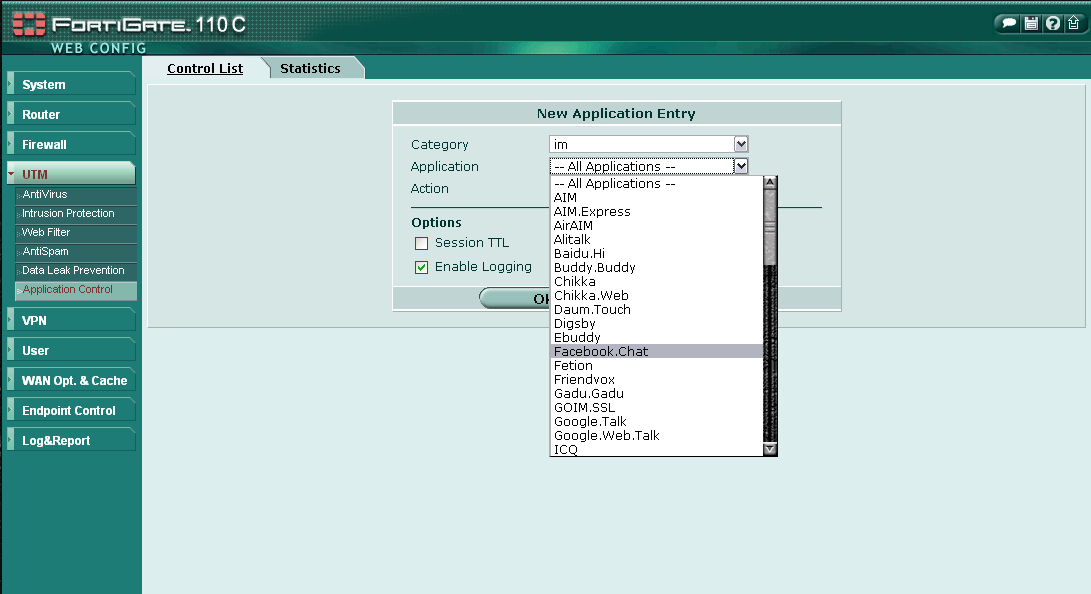
I was discussing this with Dave Ward, one of our Tech Consultants, who mentioned that Fortinet have now brought out Spam2.0 filters for their firewalls.  Social Networking sites have started having their vulnerabilities exploited. 

People are getting spammed with direct messages, apparently from friends.  Facebook chat, for example, is one way used to insert worms onto someone’s PC and thence onto your network.

Fortinet has an application that allows companies to let employees access Facebook whilst blocking access to applications such as chat known to be vunerable.  Screenshot below. You might need to click a couple of times on the picture to get it to a viewable size/quality.  Also check out the recent Wikipedia article on Social Networking Spam.

spam20

PS Don’t get me wrong here.  I am a happily married man and whilst I’m sure I quite like being chatted up by nice young ladies one has to ask why complete strangers, whose interests seem to be dating and meeting members of the opposite sex, would want to approach me…

Categories
Business internet

Microsoft breaking down walls whilst Opera is in the cloud

I attended Wireless 09 at Olympia today.  There were a number of talks I thought worth hearing including one by James McCarthy, Microsoft’s Head of Business Marketing. This one turned out to be a bit of a disappointment.  Probably my fault really as I was looking for details of Microsoft Mobile Applications and how they interact with the desktop.

Instead we were treated to a high level philosophical talk on removing barriers in business based on some research that Micrsoft had commissioned. Typical big company, big marketing budget stuff I thought.

I think most of the audience thought this too.  The chap next to me fell asleep and there were initially no questions.  When the questions did arrive they were on standard Microsoft products with no real link to what had been the subject of the talk.

Ah well.  James McCarthy incidentally, not to do him down, was a good speaker and was the spitting image of actor Hugh Grant.

The previous talk was by Jon S. von Tetzchner, Co-Founder and CEO of Opera Software.  Opera is an interesting company and I hadn’t realised the size that they have grown to- 675 people according to von Tetzchner.

Their browser business is based on the fact that all applications are moving into the cloud and every device needs to be able to access these apps. I doubt anyone would argue otherwise but he did put up some interesting statistics.

It was suggested that back in 1997 80% of all Applications were based on someone’s PC, with the 20% balance being web based. By 2007 he said that his had changed to only 15% being based on the PC and 85% on the web. Whilst adding a caveat that his was not a scientific survey it certainly does underline the trend.

Categories
Business internet peering

UK is becoming attractive place as an internet hub

Because the value of the British pound has dropped in recent times the UK is now becoming an attractive place for international ISP networks to connect. 

LINX in particular has seen 17  international networks join the peering group out of a total of 19 new members in the last three months.

In order to keep costs down ISPs peer with other networks.  In other words they agree to route each others’ traffic for free.  Running the LINX network obviously costs money and this is funded by the members so it isn’t a “free” service but it does play a major part in keeping down the costs to customers.

Categories
Engineer internet peering

#LINX65 notes on traffic growth

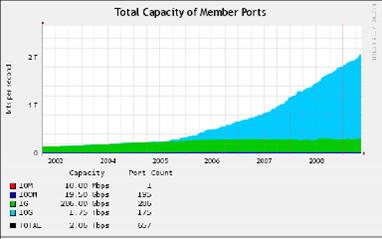
LINX CTO Mike Hughes told us that traffic across the LINX network has reached 460Gbps.  Thats up 40Gbps in the last quarter and around 60% up year on year. 

The growth is partly due to new members and whilst this isn’t a definitive statement on the growth rate of the internet it does match quite well with other sources.

In the last year the growth pas particularly come through an increase in the number of 10Gbps connections, up now to 175 ports.  The LINX team is already preparing for 100Gbps technology, the standard for which is due to be ratified next year.

linx65

The chart clearly shows the growth of the number of 10 Gig ports over the last few years.  It’s a bit grainy but clear enough. The network capacity is now north of 2Terrabits per second over 650 ports.

Categories
Business datacentre internet

Powergate initial tranche is 95% sold

Following on from yesterday’s post re Telecity’s new capacity plans in Europe the company told me today that the first tranche in Powergate, its new West London datacentre, is 95% sold. That’s 95% of 4.5MW according to Telecity, and in less than a year!

With a total of 10MW potentially available there is still some way to go but it wouldn’t mind betting that they are already looking for a site for their next UK build.

Categories
Business internet

Timico is announced as finalist for best customer service award

I’m pleased to report that Timico has been selected as an ISPA Awards finalist in the Best Business Customer Service category.

When you consider that there are hundreds of B2B ISPS in the UK Ithink this is good going especially as this is our first attempt. There was also a record number of entries this year which makes it feel even better.

Levels of service are what differentiates ISPs in this game so this is an important category to do well in. This will hopefully send out a strong message to potential new customers – we want your business 🙂 .

If you see me at the awards evening on the 9th July come up and say hello.

Categories
Business fun stuff

Trefor.net first anniversary

Just like the Queen has two birthdays, “official” and “actual”, I realised over the weekend that so do I.  “Blog” and “actual” :-).

My first blog post went out on Monday May 19th one year ago.  Since then I have written over 330 posts and had around 70,000 visits.

The year gone by has also been a successful one in business as Timico attained 4th place in the Sunday Times/Microsoft Techtrack listing and was winner of the ITSPA Best Unified Solution Award.

Trefor.net is still very much small beer in internet terms but we all have our own little worlds to live in and this is mine. It is an exciting place to be .

PS my actual birthday is the same as Donny Osmond’s! I’ll leave it to you to track down if you need to know it badly enough. I’m younger than him though 🙂

Categories
datacentre Engineer internet peering

LINX 65 and Telecity

First day of LINX65 produced the usual interesting mix of talks. Today included IPv6 and VoIP QoS.

The sponsor’s talk at the end was given by Rob Coupland, COO of datacentre operator, Telecity. In Europe Telecity operates in London, Paris, Amsterdam, Stockholm, Milan and Frankfurt. A good footprint to have.

What was interesting was the statistic he floated that the company is doubling its datacentre power capacity over the next couple of years.

I counted 26.5MW in total! They plan to sell this over the next 3 – 4 years. This is a big bet that they appear to be confident of placing based on the uptake that they are already seeing. One of the big drivers they are (unsurprisingly) seeing is content provision.

I’m not making any comment re the effect on Global Warming here seeing as we at Timico are also in the business. I guess at the scale that we are talking about though cooling efficiencies will make a huge difference.

Categories
Business internet

FTTH final installment

For completeness the last two videos in the series including the connecting and lighting of the fibre. You need to follow the posts from the beginning of the week to get the full story.

Categories
Business internet security

Britain needs eJudge

Had a meeting yesterday with the Police Central eCrime Unit in London together with a few other leading ISPs and content providers to discuss how the industry can help tackle eCrime.

Part of the problem is the speed at which things happen in the internet world when compared with the “good old fashioned” Old Bailey style of justice where response times are slow and delay is the norm . 

For example a police officer working on a case can take days for to obtain a court order requesting data on a suspect from an ISP.  In this time the gang has moved on and is lost to the justice system. A Communications Provider needs a court order to do this as providing such data without one is in breach of privacy laws, despite the cause notionally being a good one.

The solution is likely to be to put a system in place to speed up the process.  Whilst speed of communications between police and ISP could possibly be improved it seems to me that the whole area would benefit from specialist “eJudges”. 

An eJudge would be conversant with the  workings of the internet and being able to respond in real time to requests for Court Orders.  Such a judge would not have to sit in on normal court sessions.

The bit about understanding how the internet works is a real issue.  In recent times ISPs have been the subject of court orders requiring them to “remove certain websites from the internet”. 

Whilst an ISP can take down a site hosted on its own servers it can’t completely remove it from the internet because that site is likely to be cached in many places (countries) and could be easily replicated elsewhere.

In this instance the ISP would likely be in breach of the court order even though it had removed the offending site from its own server.

I realise that it is unlikely that a court would pursue the ISP in such a case but this does hilight the ignorance of  the judiciary in these matters.  

Rumpole of the Bailey is not equipped to cope with modern criminals and specialist eJudges would be a very cost effective solution.

Categories
broadband Business internet

Broadband Fibre Farming Tails – The Happy Ending

Last episode from the broadband fibre network laying story that has gripped the nation (see earlier posts here and here if you missed them). I am pleased to say that it has a happy ending, and Wennington now has two more users connected by high speed link to it’s network. Shame about the 2Mps backhaul.

As I write, I understand that the Digital Britain Report has been completed and is awaiting publication on 15th June. I believe it has the 2Mbps USO clause in it, and also some support for Next Generation broadband access in rural areas. Whether this is new money or simply rebranded existing EU funding remains to be seen. Let’s hope this broadband fibre video story becomes a quaint historical note sooner rather than later.

Anyway here’s the video.

Categories
End User internet

I love the French

It was only on 6th May that the European Parliament rejected Article 8 of the Telecoms Package Review.  This was the one that called for the “three strikes and you’re out” termination of broadband connectivity for anyone repeatedly found to be indulging in illegal P2P piracy. It was widely reported.

Yesterday the French Parliament under the direction of President Sarkozy did exactly the opposite of this.  I’m sure it is going to cause a huge furore.  If they have any sense UK plc will let it play out in France before having to decide what to do in the UK.

I can’t beat the FT for reporting resource so you can read their spiel on the subject here.

Although we complain when they have air traffic control strikes, baggage handlers go slows,  port blockades etc we do sometimes get good value for money from across the channel :-).

Categories
Business internet

Episode 2 – JFDI – Just Farmers Digging for Internet access

This is episode two of the Lancashire based rural soap opera in which farmers dig for victory in the Battle of Digital Britain and Fibre To The Home. Yesterday’s post attracted a lot of attention which suggests there is a great deal of interest in this subject. 

Note in this acronym infested industry I had never quite understood (I’m an innocent boy from small town Wales) what JFDI meant and obviously kept quiet about it to avoid embarrassment.  Now I realise it stands for Just Farmers Digging for Internet Access! :-).

Looks like there might be a third episode coming along in this video manual on how to lay fibre. NTL et al take note!

It really does feel as if you are there when you watch this video. Good luck to all rural dwellers everywhere.

Categories
broadband Business internet

Farmer Rolls Out First Rural Broadband Fibre Network as Digital Britain Takes Too Long

On the hills high above Wennington in Lancashire the local community is taking its internet destiny into its own hands and is laying broadband fibre.

The Wennington/Wray communities were no hopers when it came to the provision of ADSL so in 2005 they were awarded a £25k grant by the North West Development Agency to roll out a 2Mbps symmetrical mesh wifi network. The initial 12 users charged themselves £25 a month which provided a kitty for further expansion of the network to 22 endpoints.

They are now at the point where the remaining 30 homes/businesses are out of reach of wifi and the only way to get connected is by using fibre.  The YouTube video, hot off the press this morning (thanks to Lindsey Annison for that), shows the first cable run being laid.

This is initially an experiment to get to understand the costs involved before deciding when to add more locations to the network.

The network is a huge boost to the quality of life in the community allowing workers to stay put instead of commuting as far afield as Manchester and Edinburgh.

It is clear from the numbers here where the issue surrounding Universal Service Obligations being discussed in the Digital Britain Report reside. That initial £25k served 12 users –  just over £2k each – which realistically can never hold down a business case based on £25 a month. Being generous that probably would result in £1,500 Gross Margin pa which will never repay the initial investment.

There are problems for the community in increasing the size of their 2Mbps backhaul. A 100Mbps link to Lancaster would cost £76k to install with a £64k pa ongoing cost. This is almost an order of magnitude higher than the same connectivity in large metropolitan areas that would also have many more users at the end of the line.

It ain’t going to happen without Government assistance and I believe that it is key to the economy for UKplc to provide this. Now is the time to make it happen.

Find out more on the Wray village website with thanks to cyberdoyle for the info and  Fibrestream, Lucidos and Optech Fibres who have helped with this initial fibre project.

Check out the promo video of the initial project here.

Categories
Business internet social networking

Speeches 2 b reduced 2 140 chars at nxt election

We all have to suffer over exposure to politics during the run up to an election. It is going to get worse!  The next UK General Election will be played out in minute detail and in glorious Web2.0 technicolour using Twitter.

In fact there is now a website dedicated to furthering this cause.  Tweetminster.com is a wonderful resource for those actually interested in politics. The site concentrates the tweets of MPs, sorts by party, constituency and by subject matter and even has a tweetometer that indicates who is ahead in the tweeting game on any particular issue.

You will be an expert on MPs views like never before and the resource makes it easy to engage an MP in debate on a specific topic.

One wonders how we will cope with the sheer volume of information that will be coming at us, other than by switching off of course.  There is definately something advantageous to be said here about the British election system when compared with that of the USA.  At least we will only be getting a few short weeks of it rather than the protracted years they take across the pond. 

I can see another spike in internet bandwidth usage coming..!

If anyone is interested I did a search for the topic “expenses” on tweetminster and came up with 161 references 🙂

c u l8r

Categories
Business internet

Carphone buys Tiscali

I know this is big news in every single media outlet there is today.  CPW has bought Tiscali for £236m making it the second largest broadband provider.

So what can I add to all that is being said?  Whilst the “big six” is now the “big five” there are still hundreds of small ISPs out there serving niche, mostly business to business customers.  The time will come very soon I think that this base of hundreds of service providers will have to shrink. 

Many ISPs are now 10 – 15 years old having started during the initial dial up boom.  Most are “owner operated” with proprietors facing a difficult time ahead and the need to find capital to invest in new capacity and at the same time facing the cost pressures applied because of consumer ISP pricing strategy.

Another tier of B2B ISPs is going to emerge as clear winners.  Just being an ISP will not be enough. These will be specialist Communications Providers able to satisfy the complete range of business communications requirements. These companies already exist but the gap between them and the rest will become wider and the day will come where most of the small businesses will disappear.

Categories
End User internet

Consumers have no voice

As a footnote to yesterday’s posts from the ISPA Legal Forum one of the things to have stuck in my mind is that consumers are not being consulted in any part of the discussion surrounding P2P filesharing.  Whilst the inter industry argument rages we are in danger of losing out on some basic human rights.

Categories
Business internet

Digital Britain Final Report delayed until end of June

A very interesting ISPA Legal Forum session this afternoon yielded quite a bit of bloggable stuff, some of which has already been covered in posts earlier this evening.

The Legal Forum format was based on a panel session that included Clive Gringras as Chair, Simon Persoff, head of Regulatory Affairs at Orange, Steve Rowan of the International Policy Directorate and Daniel Sandelson, Partner at lawyers Clifford Chance.

Firstly the Digital Britain Final Report which was meant to be out in mid May is now likely to be delayed due to the “purdah” that is applied to such publications during election times – there are both Local Government and European elections in the forthcoming months.

Secondly the formation of a Digital Rights Agency, touted as part of the initial DB Report now seems to be far from a done deal. Many of the stakeholders involved thought theRights Agency was a bad idea. The ISP industry thinks it could be ok provided it steers clear of enforcement (of the law against copyright infringement by illegal downloading).  The Music Industry thinks it is a good idea provided it only focuses on enforcement.

ISPs say that the Music Industry is trying to avoid being seen as the bad guys by getting the ISPs to do the dirty work by terminating the broadband connections of (allegedly) guilty parties. ISPs don’t want to be seen as the bad guys, say that switching off broadband connections is disproportionate and if forced to do would want to fully recover their costs from the Music Industry. 

Because Copyright Infringment is a civil offence any costs incurred in the enforcement of private commercial rights, which is what the Music Industry wants the ISPs to do, can be recovered.  In this case by the ISPs from the Music Industry.  The Music Industry is saying it won’t pay. 

This is all looking like a right buggers muddle and I can’t see how it can end amicably. All this when a Government survey (in Glasgow for what it is worth) suggested that illegal P2P downloading is rife, nay becoming mainstream.

It isn’t possible to fully distill two hours of intense and useful discussion into a short blog post but I will finish by saying that it seems to me that the Music Industry is onto a loser and needs to reinvent it’s business model which at the moment it seems incapable of doing.  In going after the ISPs it is picking the easiest target. Is a search engine (Google?!) equally responsible becasue it helps transgressors find out how they can break the law? 

As an experiment try searching on Google for “how to download free music albums”.  You will find 48,900,000 links on this subject. The cat is out of the bag and isn’t getting back in.

Categories
Business internet

20% increase in P2P downloads since Pirate Bay court case.

At the ISPA Legal Forum today it was stated that research has shown that illegal P2P downloading has increased by 20% since the high profile Pirate Bay court case.

This was revealed as the result of a recent 3 month research study into Consumer online behaviour by University College London academic Robin Hunt. Hunt said that a snapshot of Bit Torrent activity indicated that there were 1.3 million sharing sessions online – up 20% from before the litigation.

He also stated that in a breakfast meeting yesterday with David Lammy, the IP Minister had estimated that there were 10 million people in the UK involved with illegal P2P downloading.  The scale of this is such that if 10 million people are breaking the law then “there is something wrong with the law” said Hunt.

The prospect of criminalising 10m people is clearly unimaginable.

Other snippets from the Forum suggested that since YouTube had stopped rights holders such as Warner Brothers from posting videos to the site there had been a growth in kids uploading videos made from their own local copies.  This has lead to unknown teenagers getting a huge number of hits.

What’s more with the plummeting cost of storage – £150 can now get you a Terrabyte hard drive – it won’t be long before the whole iTunes back catalogue can be stored on a single PC. It is estimated that 10 Terrabyte hard drives will be available within two years.

This problem seems to me to be about to come to a head as we await the Digital Britain Final Report.

Categories
End User internet

Sorry kids but exams are going to get harder

All ISPA members are tomorrow being sent a letter (ispa-_-qca ) from the Qualifications and Curriculum Authority asking for their help during the forthcoming school examination season.

The QCA is concerned about the risk of unlawful publication of examination test questions on the internet and in particular that the usual routes for a copyright owner to request an ISP to take down unlawfully published information may not react quickly enough to avoid serious disruption to the national curriculum tests. This situation has apparently been the case in the past.

The QCA is therefore requesting that ISPA Members co-operate with QCA by providing alternative contact information which would be used to notify an unlawful publication of test materials and to request an emergency take down.

I am happy to help here of course. However I can see a problem with the approach. For example it is quite possible for kids to upload this information to non UK based sites who might not be interested in helping the QCA and who indeed the QCA will never have heard of.

Still notwithstanding this I can only say “sorry kids – you will have to pass the exam without an advanced sight of the questions – the way we all had to”.

Categories
broadband Business

21CN trials successfully completed

Yesterday I signed off our ADSL2+ service for production. As one of a small number of ISPs selected by BT for the trials we have been careful not to rush too quickly into using the 21CN network. As it was new we felt it was important to make sure that the customer experience matched our own business quality requirements.

After a few hundred trial connections we have been getting more of a feel for the actual performance capabilities of the network.

ADSL2+ is marketed by some ISPs as a 24Mbps technology but in fact it is unlikely that customers will achieve such high connection speeds as the actual speed achieved is very dependent on the customer’s distance from the exchange and the quality of their line. Because of this, we are promoting our offering as an “up to 16Mbps” service. As with existing ADSL connections, users experience a range of speeds. The highest we have seen so far is 19Mbps so there is a chance that people could get a faster connection than advertised.

Transparency for business customers is very important, as is responsive and professional support. I am extremely proud of the technical service levels which we provide free of charge to customers. Timico operates exclusively in the UK with its own in-house staff, rather than outsourcing customer support functions to UK or overseas contractors.