Categories
Business social networking

Last post for a week but twitter updates will keep coming

I’m off on rugby tour to South Africa tomorrow so no blog posts until Thursday 2nd April at the very earliest. Not only would I not trust myself with a laptop on tour but I won’t actually have much time to write as we have a very busy schedule.

That isn’t to say though that the blog will be inactive.  On in the sidebar to the right of this post you will see a stream of tweets that will keep people posted re my progress.  Provided there is mobile phone coverage, and I can’t always be sure of that out in the wild, I will keep the updates coming including how I get on in the two matches we are playing.

You might also, if you are going to be watching the Lions v South Africa second test at Loftus Veersfeld on Saturday, keep your eyes open for me in the crowd.  Thanks to all those who have wished me well on this trip and I look forward to telling you all about it in person at some stage this summer.

I’ll post some pics on Facebook when I get back.

Categories
Business internet

Federer at the net attracts on net audience

Here we go again.  Wimbledon.  I never used to be a Wimbledon watcher but since taking my tennis playing son to see the tournament last year (Centre Court, Murray, Nadal, Venus Williams) I have changed my attitude.

This year I’m watching it from the office.  The web traffic that is.  At 13.00 hrs our network usage shot up and looking at it it is a mix of video streams that is making it happen. The same happened during Obama’s inaugural speech, this year’s budget speech (why?!) and last summer’s Olympics.

The effect is a bit like half time at an FA Cup Final when half the country gets up to make a cup of tea.  The other half of course gets up to go to the fridge to get another beer. Those kettles all going on at the same time ramps up the demand on the electricity network just like Roger Federer does for the internet.

I’m not really a football fan myself.  Come on Andy Murray!

Categories
datacentre Engineer

It's all about wiring

Following my post on our fibre installation earlier in June The build of our new datacentre module in Newark continues.

Datacentres, whilst giving the appearance of being high tech,  are all about wiring and plumbing.  So I’m getting in the cable monkeys and plumbers.

Couple of photos below give you a feel for part of the process. Underfloor power connections to each rack space and a coil of fibre that might look innocuous but will carry the lifeblood of the datacentre, ie the data itself.

It makes me think of the pony express, or the old stage post mail system and how things have changed. I’m getting romantic in my old age.

cabling


fibre


Of course it will be tidied up a bit before we open for business.

Categories
datacentre Engineer

It’s all about wiring

Following my post on our fibre installation earlier in June The build of our new datacentre module in Newark continues.

Datacentres, whilst giving the appearance of being high tech,  are all about wiring and plumbing.  So I’m getting in the cable monkeys and plumbers.

Couple of photos below give you a feel for part of the process. Underfloor power connections to each rack space and a coil of fibre that might look innocuous but will carry the lifeblood of the datacentre, ie the data itself.

It makes me think of the pony express, or the old stage post mail system and how things have changed. I’m getting romantic in my old age.

cabling


fibre


Of course it will be tidied up a bit before we open for business.

Categories
Business internet

ISPA Awards 2009 Internet Hero and Villain finalists

It’s worth looking at the heroes and villains finalists for this year’s ISPA Awards. The spiel that goes with each is an adequate summary of why they are in the list and needs no further comment from me. The heroes all deserve to win and the villains all deserve to lose.

On balance my vote goes to Stephen Carter for Hero. Whether he will have left a worthwhile legacy with the Digital Britain Report remains to be seen but at least he tried.

As far as Villains go I think they should all be locked up in the big brother house and the winner is the winner, if you know what I mean. Otherwise if I had to vote I’d go for Sarkozy because of the port blockades, air traffic controller strikes etc 🙂

Internet Hero

• Billy Bragg and the Featured Artists Coalition – “For recognising publicly that the focus of music companies should be the development of new business models for distributing content online rather than attempting to pass responsibility to ISPs to take action against users”

• Community Broadband Network – “For their relentless pursuit and support for next generation access at grass roots level”

• European Parliament – “For rejecting by a significant majority an amendment to the Telecom Package designed to allow disconnection of users’ Internet connections for alleged copyright infringement without direct judicial oversight”

• Lord Carter – “For his attempt to bring a holistic view to government policy across the communications spectrum”

• Thomas Gensemer – “For showcasing the enormous power of the Internet in leading Barack Obama’s online presidential campaign”

Internet Villain

• Baroness Vadera – “For excluding a number of ISPs and Rights Holders in agreeing a Memorandum of Understanding that was exclusive and ineffective in progressing relations between the two industries”

• European Parliament – “For supporting an amendment to the Telecom Package on cookies which could yet bring the Internet to a standstill”

• President Nicolas Sarkozy – “For his continued commitment to the HADOPI law, which advocates a system of graduated response, despite repeated arguments suggesting the law is disproportionate from a number of important groups including the European Parliament”

• Stephen Conroy and the Australian Government – “For continuing to promote network-level blocking despite significant national and international opposition”

Following the publication of the Digital Britain Report there was a late entry suggestion that Lord Carter might also appear as a Villain with his 50 pence tax on phone lines. This missed the deadline so he stays as just a goodie on the list.

Timico has a table at the ISPAs. Look me up if you are there.

Categories
Business internet

NGA funding in Digital Britain can only be a start

Two funding streams have been identified for the 2Mbps Universal Service Obligation and the longer term Next Generation Access  broadband. The 50 pence per analogue line will raise about £180m a year and the diversion of funds from the unused digital TV switchover fund will account for £200m.

I guess my point is that in last year’s Caio Report the NGA network was estimated to cost £29Bn and a large proportion of this would have been spent in areas that currently can’t get broadband and would be in the USO area.. The per line cost of providing 2Mbps is probably not much less than the 40 or 50Mbps talked about in NGA.

So the funding identified for USO can only be a start and there is a scenario where they might just as well go straight for the fast stuff.  It is good that the Government has recognised that the Digital Divide exists but they do need to do more.

Categories
broadband Business internet ofcom

Initial Take on Digital Britain Report

2Mbps Universal Service Obligation by 2012.
This is the minimum that people need to get into the game. In the report the government recognizes that whilst much of the country will shortly be getting access to faster broadband (aka BT 40Mbps Fibre To The Cabinet or 50Mbps Virgin cable) a significant chunk won’t, which will exacerbate the Digital Divide.

The Government is therefore looking to promote/fund the extension of this Next Generation Access network into these “excluded” areas. I have been saying that 2Mbps is not enough and it is good that the Government clearly recognizes this.

The funding for the rural Next Gen broadband access is likely to come from a complex variety of sources. It includes a new tax levied of 50 pence on every copper phone line. I assume it includes Virgin cable connections to keep the playing field level. This will have to be passed on to customers so the immediate effect is a rise in the cost of broadband. It will also add to the overheads of the ISP which has to collect it.

The funding collected will be available on a competitive tender basis. I would expect the Government to somehow identify specific projects for funding and make the moneys available for competitive bids. Otherwise someone with BT with the massive resources available to put specific projects together would cream all the cash.

Music Piracy
Two things to say here. The Government recognizes that access to legal means of downloading music needs to improve which reinforces what the ISP industry has been saying (note the many blog posts on this subject).

Secondly the Government also wants a more graduated approach to punishing illegal downloaders. The three strikes and you are out approach has been replaced much to everyone’s relief.

We now appear to be looking at a scenario whereby the ISP would send a letter to the end user informing them that they have been identified as offenders. The next step would be to throttle the bandwidth available to users indulging in this activity or block P2P. The final resort would be legal action.

A cautionary note here. Most ISPs cannot easily block P2P. Only those big consumer players typically have the kit that can do it. Are we looking at the same scenario as the Data Retention Act where the Government only expects an ISP to follow the law only if specifically asked. In this case the ISP would have to be funded to do it.

There is also a fairly significant onus on Ofcom to make all this happen which is going to be an interesting play. I imagine it will take no small level of resource which probably doesn’t currently exist.

All in all I think this is a good report.  There were always going to be difficulties with putting together a document with such a wide remit and I’m sure that as we get time to digest it other questions will arise.  However Lord Carter should be able to move on to his fresh challenges with a reasonable sense of satisfaction.

Categories
End User internet media piracy

94 percent say they would choose a legal music site over a pirate one

Bit of a long post title but this is the feedback from research conducted in June on consumer behaviour and preferences in respect of music downloading.  The research was commissioned by music site We7 and conducted on 2012 consumers aged 16 to 60 over 7 days in June 2009.

Its key findings make very interesting reading:

  • 46% of UK music fans do not understand how to legally consume music online
  • 64% do not know how to stream and share music legally
  • 85% of consumers are happy to listen to a short ad in exchange for unlimited access to free music that they can share with others
  • 94% say they would choose a legal music site over a pirate one if it had the same range of music and was easy to use
  • Women and those over 55 are least likely to stream – 85% say they don’t know how and are unlikely to try
    64% of 16-24 year olds share music with friends online and 71% know what streaming is but only 48% have ever tried it
  • Londoners and Bristolians are the biggest sharers of music online but only 39% and 46% respectively have ever streamed music. 
  • The majority of music buyers (78%) would buy the same or more music if they could listen to streamed music too, showing that the We7 model compliments the industry rather than cannibalises it

All this reinforces the ISP industry’s position that what we need is more legal ways for consumers to easily access music online.  7  million consumers can’t be criminals.  We7 is doing a great job pioneering this so thanks goes to Steve Purdham, and his team. 

Tonight I’m going to go home and listen to some free and legal music streaming online. Frank Sinatra methinks.

Categories
Business internet piracy

Virgin agrees anti-piracy music deal

Virgin has announced a deal with record label Universal that will provide unlimited access to the company’s music catalogue for a fixed monthly fee.  The level of this fee is as yet unnanounced but is reckoned to be the equivalent to the cost of two albums. The service will be available by Christmas 09.

The biggest aspect of this news is that Virgin has also undertaken to attempt to tackle the problem of online music piracy with the ulitmate disconnection a potential penalty for persistent offenders.  This appears to be a big step forward and is likely timed in advance of the Digital Britain report, delayed now until later this week.

This deal is likely to bring pressure to bear on other large consumer ISPs.  It does remain to be seen how the removal of broadband service from persistent pirates (to put it poetically) is handled.  This has been the one aspect of the debate that has had ISPs up in arms. They don’t want to be seen to be doing the police’s job.

The Virgin paid for model is of course different to the We7 advertising funded service discussed last week. The whole area is of a great deal of interest to many people.  My We7 posts get more hits than any other published item on this blog.  Helped no doubt by the fact that I have been giving away free We7 promotional codes :-).

If you want one let me know. I got a fresh batch in recently.

Categories
broadband Business Regs

Digital Britain Final Report Delayed a Few Days

BERR on Friday issued a statement to say that the Digital Britain Final Report will not now be released on Tuesday as planned. Instead it is being presented to the Cabinet tomorrow and will be released later in the week.

There is also a meeting between Lord Carter and a few industry representatives tomorrow afternoon.  ISPA is being represented at that meeting so I will report back later.

There is a huge amount of expectation surrounding the publication of the Digital Britain report.  We think we know what is going to be in it but can’t be sure. However it turns out I’m sure it is going to spark a huge amount of debate.  Let’s enjoy the last few days of peace before it hits the street 🙂

Note the BERR statement isn’t actually a BERR statement. It is a Joint statement from Departments for Business, Innovation and Skills and Culture Media and Sport. I’m not politicaslly motivated but this does seem ridiculous. BISCMS ?!!! I could only just get my tongue around BERRRRRR.

Hot off the press – apparently the report will now be available on the DCMS website at 3.30 pm tomorrow.

Categories
broadband Business internet ofcom

Broadband Internet Access. Ofcom says 1 in 5 of Households Without Will Get It Within 6 Months

Ofcom says Broadband Internet Access is coming to 1 in 5 currently without it.

An Ofcom study suggests that 2 in 10 people without broadband internet access at home intend to get it within the next six months.  They say that 70% of us already have it (68% broadband internet, 2% narrowband!). So the 20% of the remaining 30% suggests that 6% of the whole population will rush to sign up in the next 6 months.

That’s a fairly significant number of people signing up for broadband internet access.  Being a bit of a sceptic sometimes I did read the report (exec summary anyway, me being an exec and all) to see whether I could believe it.

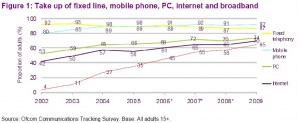
Actually, there is one simple metric that does tend to support the number:  growth in people with PCs at home. The chart below shows the growth in fixed, mobile, internet and PC use at home.  You can see that a significant 4 percent of people have a PC but not an internet connection. That together with a continued growth trend does suggest credibility.

Note the flat mobile growth and the gradual decline in fixed line.

ofcom broadband internet access

Categories
Business internet

ADSL growth is turning into ethernet growth

There has been a land grab for broadband over the last few years with some high profile industry consolidations aimed purely at growing market share and bulking up what has long become a commoditised ADSL business.

Whilst the ADSL growth has not stopped at Timico we are seeing a trend of businesses installing leased lines as well as broadband.  Companies are becoming increasingly reliant on the internet and IP communications to run their business critical applications. Down time costs them money and leased lines are more reliable than ADSL because there are fewer areas where things can go wrong.

Also the cost of leased lines have dropped significantly in many areas of the country as UK PLC grows its infrastructure. Going for higher bandwidth and reliability that comes with the technology is no longer as cost prohibitive as it used to be.

It is an exciting time to be around for a communications provider. I’m finding that the more leased lines we sell the better we get at doing so which in turn means we sell more.  Hooray!

Categories
Business ofcom voip

Ofcom market research

Had an interesting meeting with the Ofcom market research team.  This is the team responsible for the Annual Communications Market Report which is a must read if you are in our game.

The meeting was arranged by Ofcom’s Chris Rowsell because the VoIP service provider  industry, via trade body ITSPA, had expressed concern that the VoIP content of last year’s report showed a decline in consumer use of the technology.  This was not the actual experience of the ITSPA membership so this year we wanted to try and help make sure that the research that was conducted was more accurate.

After the meeting I did come away with a certain degree of sympathy for Ofcom.  It is very difficult to come up with an easy definition for VoIP that can be understood by the general public so that accurate research can be conducted. 

It didn’t really help that some of the example service providers used by Ofcom in the research questionnaire were of services that no one in the room had ever heard of. If industry experts could not answer what chance Joe Public?

Another interesting part of the mix is that the only bit of the Annual Report that Ofcom is required to cover under statute is the TV market. This means that the mobile/fixed line telephony/internet bit is optional and the regulator is only interested in covering bits that might affect the legislative decision making process. So consumer VoIP is of interest to them but not business VoIP.

As a Business to Business VoIP provider Timico, along with most ITSPs in the UK is only interested in the business market numbers. This is somewhat disappointing to the industry which is left without a particularly accurate metric of its size.

We left the meeting with a some positive actions. Ofcom is quite happy to take on board suggestions from ITSPA as to how the research can be improved and although there isn’t much time this year to get it done, this is something we will take onboard. Secondly, in the absence of their own data, Ofcom appears to be willing to publish the numbers collected by ITSPA member and Communications Consultancy Illume which gathers basic industry subscriber numbers on a quarterly basis.

Hopefully we will be able to help improve  the VoIP aspect of the report this year.

Categories
Business internet media

We7 cracks free online music streaming business model

I have been getting more and more hits on an old post about We7 where I was giving away promo codes for free music downloads.

In a dialogue on this subject with We7 CTO Gareth Reakes I was extremely impressed to find that they seem to be on the way to cracking the business model for giving away “free” music online.

The whole music streaming business model has been a debating point with the content industry for the last 12 months or so as ISPs and the Music Industry struggled to find a viable, mutually beneficial approach.

Several big name sites have got into difficulty over the model. YouTube have allegedly lost hundreds of millions of dollars (apparently 89% of YouTube traffic is(was) music) and imeem.com allegedly in debt to the record labels for tens of millions.

It is easy to attract visitors to your website if you are giving something away free but not so easy to make money.

What We7 has done is to fine tune the model so that the revenues balance out the costs.

Reakes said “We are trying to grow at while increasing ad revenues as we go and ensuring the model can work. What it comes down to is the number of ad impressions you get per stream you serve (this includes ads as they surf around the site looking for new content). With us that ration is between 3 and 4.

What this means is that you can get to a reasonable CPM rate (cost per thousand impressions – its how ads are priced) which is as low as £2.50. This really is an achievable rate. That’s not even factoring in the recent MCPS/PRS reduction in rate from 0.22p to 0.085p which reduces our costs per stream by over 10%.”

The key here is that We7 can get as many as 4 ads in your face/ear whilst you are listening to a track. This adds up to the equivalent of a CMP rate of £10 whilst the advertiser is on average only charged £2.50. Compare this with up to £60 at the FT and £25 at the Register. Not the same target audience I know but it does give you a feel for the attractiveness of the rates.

The reduction in the MCPS rate has also been a big help although this together with payments to the record labels still amounts to around 1 pence per stream.

We7 has been growing at a very attractive rate.  Reakes again:

“We will reach a couple of good milestones soon (we are nearly at million monthly unique visitors). I suppose one of the most interesting things from my point of view is that we are starting to get great reach with our widgets. We now have partnerships with The Guardian and NME where they show the widgets. They are also picked up in many many other places. The whole distribution of music and being able to listen to it anywhere is very interesting. We have had .75 million unique visitors to the widget on all its sites in the last 30 days! (that excludes anything on our site).”

This is a great story and the team at We7 is to be congratulated on their progress. I didn’t ask them whether they have reached profitability yet but this suggests that it can only be a matter of time.

I have had quite a few unanswered requests for We7 promo codes recently. Hold on tight guys and I’ll send some more out this week. Also We7 have said that if I want more to just ask so keep the requests coming. This batch is for ad free music.

Categories
End User internet scams security

Email scams

I went in to BBC Radio Lincolnshire this morning, as is my occasional wont, this time to talk about email scams. I am not particularly a security expert but I guess being in the ISP game I would get more exposure to this than your average Radio Lincolnshire listener.

It was all about phishing emails from people after your bank account details, and especially spoof emails notionally from people you know. As a bit of background research I googled “how to hack MSN” and I was astounded to find 952,000 websites on the subject.

Similarly there was plenty on Twitter and no doubt there will be stuff out there on Facebook and others. I didn’t follow more than a couple of links and the first article had already been removed. It does certainly highlight the vulnerabilities of the web.

I get phishing email daily, mostly caught in my spam quarantine folder, and all of which get ignored/deleted. I do get some very genuine looking spam though appearing to come from reputable contacts.  In one example a business partner of Timico’s had its contact databased copied a number of years ago.  I still get spam appearing to come from this partner.  There is nothing they can do about it. The data is gone.

I have never personally met someone who has been caught out by one of these phishing attempts. Not that is until last night when a friend rang me up and during the conversation mentioned that it had only just happened to him. He was busy and stupidly responded to an email and typed in his bank account details!

Luckily for him the bank spotted an unusual transaction and refunded the cash after calling him to check. It just goes to show how easily it can happen – to the unwary.

Categories
Archived Business

Arm of steel – customer support training

Rock solid networks are an expectation of our customers. It takes a strong steady arm to run such an operation and it will comfort readers to know that on Friday afternoons the technical and customer services departments get together for training.

The photos are of me in training with Michelle, our Director of Customer Services. Note the motto on the wall in the background on one of them.

tref_michelleIn case anyone asks yes I did win! As usual – girls huh.michellearm

Categories
Business internet

Light relief – fibre to the premises

We are just in the process of installing a 1 Gigabit Ethernet fibre link to the Timico Headquarters in Newark.  The process is in massive contrast to our friends in Wennington, Lanacashire who have had to get a digger out and become experts at diy fibre laying.

In our case this first Gig link will go into existing ducts. See photo below.

newarkfibre

This 1Gig link is actually the first of two diversely routed fibre connections that we are putting in to increase resilience to the site. I’m goingto follow the upgrade together with developments in our colo offering in pictures on the blog.

The photo does bring a wry smile.  The fibre, if you can make out the colour is lilac.  The blue is the thin rope that is used to pull the fibre through the ducts – in theory this is left in place underground in all ducts for this very purpose. It makes me think of the tin can and string telephone analogy.  The string can carry a single conversation. The fibre, as it stands, could carry around simultaneous 20,000 calls.

Lastly I did struggle with the title for this post.  “You light up my life”,  “let there be light” and “trip the light fantastic” all sprang to mind. Take your pick :-).

Categories
Business internet

Ethernet in the First Mile – EFM

I’m happy to say that Ethernet in the First Mile is starting to get customers excited. EFM?  Yet another !”£#@ acronym do I hear you say?

Yes and actually EFM is quite an exciting proposition in 21CN enabled exchanges around the country. That’s around 600 now with notionally 1,100 by the time BT has finished the rollout.

EFM is a copper based Ethernet service to the customer, capable of carrying high bandwidth connections without the need for fibre into the customer premises. It provides “up to” 10Mbps (<3km from the exchange).

The beauty of the technology is that it bundles up to 5 copper pairs from the exchange to the premises to attain the bandwidth throughput. If any of these pairs “go down” then the service will rate adjust to a lower speed based on the remaining circuits rather than failing completely.

Whilst customers don’t necessarily get the reliability and uptime of a fibre leased the EFM circuits are considerably cheaper with much faster installation lead times (and don’t get me wrong – I’m not saying EFM is unreliable – it’s basically the same as ADSL).

What’s more we can incorporate EFM connections into an MPLS VPN/PWAN.  EFM gives businesses far more flexibility in the type of circuits they can build into a network design.

It does strike me that anyone thinking of getting into the ISP business these days is onto a loser.  Timico has its own direct connection to BT for EFM.  This is in addition to circuits for SDH, framestream, Ethernet, SDSL/ADSL, ADSL2+ and 3G (wireless). 

We also have direct connectivity with BT Wholesale, BT Openreach, Telewest/NTL/Virgin (whatever you are used to calling them), Global Crossing, Claranet, Tiscali (ahem) and Cable and Wireless, notwithstanding our links to transit providers and peering exchanges such as LINX.

I’m not saying that the situation is different to what it was like 5 years ago when Timico started. At that time our decision was to buy Atlas Internet to get into the game and since then we have added two further acquisitions.  The complexities and the scale required to be competitive have however changed.

Our first BT central pipe (ie wholesale ADSL connection) was a single 34Mbps link.  Now we are into multiple 622Mbps and multiple Gigabit fibre.  These represent large cost commitments that new entrants should balk at or at least recognise that they would have to have very deep pockets.

Note 1  !”£#@  = “bloomin”

Note 2 apologies to friend and blog reader Dan Ellin who has made some comments on Facebook regarding the number and incomprehensibility of acronyms in this industry 🙂

Categories
broadband Business internet

BBC Claims BT is Throttling iPlayer

The BBC has an article online regarding the fact that BT is broadband throttling the iPlayer traffic of customers taking “Option1”.  Option1 appears to be BT’s cheapest broadband package at 8Mbps with a 10GB download limit.

I’m afraid that it is a fact of life that ISPs cannot afford to keep providing the services they do at the prices they do without some element of constraint over what consumers can download.

BT’s website does have a long list of caveats for its broadband service. They are quite open about the fact that they “network traffic manage” P2P and video streaming between their peak hours of 5pm and midnight although you might argue that the fair usage policy has become quite a complex one for people to understand.  Also whilst openly promoting the fact that users can watch online TV they fail to mention that only the lowest quality iPlayer setting is accommodated at these peak times.

The problem is about to get worse as higher speed 21CN connections become more prevalent and trials about to begin on 40Mbps services using Fibre To The Cabinet. Customers will expect to be able to get high quality video streaming  with these services.  Indeed video and likely HD video, will be one of the drivers for uptake of faster broadband.

Note whilst checking out the BT website I observed that the company sells its 10GB download limit as the equivalent of 2,500 music file downloads, 14 videos or 25 hours of streaming iPlayer a month.

This riles the music industry no end.  Does anyone believe that consumers download 2,500 “paid for” music files?  Is BT inadvertently helping to promote illegal P2P filesharing here?

Categories
Archived Business

Job vacancies at Timico

We are currently looking for ISP first line tech support engineers and ADSL/IP provisioning staff to join our expanding teams in Newark. 

Timico is bucking the recessionary trend with a growing managed networks business. If 21CN, IP, VoIP, MPLS, co-location, Virtual Machines sound exciting then take a look at these jobs. Please contact Timico if you are interested. Experience would be great. Technogeeks with a professional attitude and a friendly nature are ideal.

This is clearly a job ad. I’m not really interested in flowering up the jobs, “great career potential” etc but I will say that our first tech support engineer now runs several tech support teams and has team leaders reporting into him.

This is a foot on the first rung that could progress you into Network Operations, Tech Solutions/Network Design, Technical Sales or any other of the many disciplines in the fast moving communications world. If you are good the sky’s the limit.

In 2008 Timico was 4th in the Sunday Times/Microsoft Techtrack 100 table of the fastest growing private companies in the tech sector. We also won the ITSPA award for the Best Unified VoIP Solution.

If you can get in quick you might make it in time for our Summer Barbecue:-). Work hard play hard.

Categories
Business internet

Copycats? Digital consumers in the online age.

I woke up Friday morning to a BBC news report claiming that a report had found that there were 7 million people in the UK indulging in illegal file sharing. This was based on a report by the Strategic Advisory Board for Intellectual Property and one which I have been looking forward to reading.

The report does in fact make very interesting reading though even the executive summary is fourteen pages long so I’m not going to replicate it all here. This then is the executive summary of the executive summary with bits left out.

Between 44% (USA) and 79% (Eastern Europe) of internet traffic is taken up with illegal file sharing. As a B2B ISP Timico does not see this level of P2P though I can understand why consumer ISPs invest heavily in packet shaping technology.

Up to 7 million people are illegalling downloading music and movies.  With only 2.3 million full time students this must mean that non students are also doing it.

A large number of people assume that they can get such material for free and that they won’t get caught.  This is changing basic assumptions about the idea of ownership,  sharing and copying content and that new business models are needed.

The report also does suggest that industry, ISPs included, need to play their part but recognises the difficult situation that ISPs are in.  If consumers get clamped down on will this change the way they behave generally in using the internet?

All this is good reading in the run up to the publication of the Digital Britain Report in a couple of weeks time. Although I hope I am wrong I increasingly get the feeling that Digital Britain is not really going to come up with any kind of solution to this problem.

Both the exec summary and the full version of the SABIP report can be found here.