Categories
Business internet

UK Council For Child Internet Safety

The UK Council For Child Internet Safety (UKCCIS) was launched today at the Science Museum in London. This initiative is supported by the Prime Minister to whom the council will report directly.

The council is made up from a number of government departments and in the words of the Department of Children, Schools and Families (DCSF) brings together a wide range of experts from industry, education, law enforcement and children’s charities.

The clear aim is to make internet a safer place for children. Timico is participating via the ISP Association. One of my fellow ISPA Council members is on the Exec Board of UKCCIS. You might ask why a B2B ISP might concern itself with child safety? The answer, simply, is that Timico has several thousand homeworking customers that use its ADSL connections.

It behoves us all to understand whether there are working practices that can be implemented that makes the world safer. I cannot believe that there is a single homeworker out there who would want their ADSL connection to be the conduit by which their children’s safety is compromised.

Moreover more and more large organisations now use Timico homeworker solutions. It is important that they understand that they are working with a partner they can trust to support their obligations for corporate responsibility.

Categories
Business fun stuff

4th Fastest Growing Technology Company

It’s not often that reading the Sunday Times gives me a thrill. It did today because I came across the Techtrack 100 supplement and discovered that Timico is now rated as the fourth fastest growing business in the table.

Last year we ranked tenth which we felt was quite an achievement. This year I had forgotten all about it so the surprise is doubly pleasant.

This is an exciting time to be around in the communications industry. Lots happening. Lots of change. Companies have to be nimble to succeed and I think Timico is fortunate to have people with the talent to make things happen.

Watch this space!

Categories
Business internet

Staggercast

Shakespeare used to introduce a few hundred new words in each of his plays, many of which were never heard of again, odsbodkins!

It’s the same these days in the technology business. Staggercast is the means whereby subscribers can preregister their interest in a TV programme. This programme is then downloaded in advance ready for local delivery at the published time.  This allows content delivery over an IP network but avoids the over use of a connection at peak times of day.

This was one of the options being discussed by Simon Orme, BT’s new GM for Content Delivery. In London today Orme presented the Consult21 meeting with an overview of the BT trial plans for multicast using PTA. Notionally this will allow ISPs to deliver TV over DSL at much more economic rates.

Don’t get too excited though. This is very much experimental engineering work with no immediate plans to productise. The idea is that an ISP would be able to add premium rate TV as a bundled product. It would also provide a low cost delivery vehicle for small regional TV channels as the focus of the established media moves to national and global content. 

What is clear is that this is one of the early steps BT is taking in preparing itself for the business case challenge that is Fibre To The Home.

The BT FTTH trials were also discussed. They seem to have gone well with the 50 BT employees given 100Mbps internet access and ordered to stay at home all day and play online games. Gaming is one of the few current uses of internet technology that benefits from really high speed access. The faster you are on the draw the better.

Whether Staggercast enters the Oxford English Dictionary remains to be seen. What is clear is that both in the fiercely competitive field of online gaming and in the international competitive broadband stakes he who has the fastest connection will be the winner.

Categories
Business internet

Timico Goes Live With 21CN

Following on from my last post on BT’s IP Stream Connect slip I am pleased to be able to tell the world that Timico has taken delivery of its own 21CN Hostlink connection. The Hostlink is a resilient 1Gbps Ethernet link to BT’s 21CN network and allows Timico to connect ADSL2+ tails for customers using the BT Wholesale Broadband Managed Connect (WBMC) service. ADSL2+ is the latest generation of broadband offering up to 24Mbps performance.

Timico is as I understand it one of only a handful of ISPs in the UK currently with a 21CN hostlink utilising BT’s WBMC product.

If anyone reading wants to try out the service drop me a line at Timico. A list of enabled exchanges is available here.

Onwards and upwards.

PS it would be completely disingenuous of me to let you go away believing that you will get 24Mbps performance out of this service. It all depends on how far you are from the exchange. A typical ADSL Max connection does 5Mbps whilst the specification is up to 8Mbps. The chart below should give you some idea of likely performance.

Categories
Business internet

BT Slips IP Stream Connect By Over a Year

BT made public yesterday the fact that its IP Stream Connect product would not now be available until Q2 09. That’s fiscal Q2. ie September 09.  This is a huge slip considering that last November the industry was being told not to order any more ATM based central pipes and to expect to have migrated all their 20CN IP Stream traffic over to a 21CN Hostlink connection.

For the uninitiated IP Stream is the technology used by BT for most of their ADSL connections. The connections to the BT ADSL network from Timico and other ISPs use ATM. The relevance for ISPs that are BT customers, and that’s most of the ISPs in the UK, is that they will have to keep ordering old style ATM pipes.

The issue here is that these connections are expensive to install and had minimum contract terms of 12 months. This could be crippling as ISPs typically depreciate the capital spend on a BT Central over 5 years. Also they could be ordering a pipe that they might only need for three months whilst they waited for IP Stream Connect to go live whilst being tied in to a 12 month contract.

Using 21CN hostlinks offer a multitude of benefits, not least of which are improved quality and customer experience.

Fortunately BT has  responded to the stinging criticism of the ISP community, me included, and come up with more favourable contract terms.

Whilst large consumer ISPs have been heavily cricised for their not totally transparent bandwidth capping and throttling polices these are the practical results of dropping their prices to unsustainable levels. In other words you get what you pay for. It is already difficult enough for the industry to keep its prices low in the face of increased usage from applications such as iPlayer and YouTube without being burdened with more costs.

Hopefully we will now have weathered this BT induced storm.

Categories
Business internet

The Caio Report – Next Generation Access

The Caio report is in the press at the moment. Commissioned by The UK Government’s Department for Business Enterprise and Regulatory Reform (BERR – neither full name nor acronym really roll off the tongue do they?) the report looks into whether government investment or intervention is required to keep UK plc competitive in the internet access stakes.

The question was posed in the light of fibre rollouts in other countries. The conclusions, simplistically, recognising that the report itself is 100 pages of bedtime reading, told us that due to the health UK competitive market no, Government intervention is not required. Although it might be if industry doesn’t get a wiggle on.

I went to a presentation of the report on Friday at the BT Centre, Newgate in London. The room was full of financiers, network operators and vendors all interested in a piece of the action. Exciting though the prospect of fibre to the home may be, with its resultant lightning speed internet connectivity, what was clear was that nobody in the audience could come up with a business case that would justify the £29Bn bill.

BT is testing the water with a £1.5Bn investment that notionally will reach around 10 million homes. This of course, if successful, will only lead to a problem for BERR in the future. Why should BT have to invest in reaching the other umpteen million homes that are not cost effective to reach/Why should those living in the countryside be disadvantaged.

Virgin already has a fibre network that provides partial coverage. There doesn’t seem to be any money in the pot to extend this based on anecdotal evidence that new housing estates are not getting fibre even though the general area is covered by Virgin.  Virgin is though, I have to say, a business that seems to be fast getting its act together where connectivity is concerned. Amazingly having assimilated £12Bn worth of network by acquisition and merger the company allegedly did not know where it’s connections lay. When the fibre was first put in, speed and low cost were the primary focus of attention. Not the keeping of records. This is changing and the Virgin (NTL/Telewest to business users) are now looking as if they might be a highly competitive player in the fast growing fibre connectivity game.

The mobile network operators are also likely to play a role. After all the vast majority of the costs associated with FTTH are in the digging up of the roads rather than in the network electronics. Someone in the audience quoted a figure of £100 per metre for ducting compared with two pence per metre for the fibre.

The case is, interestingly, different depending on the country you are in. For example in the USA the cable provider is typically also the content provider and experience shows that punters are willing to stump up more ARPU to justify the investment. This is not the case in the UK and indeed BT research suggests that only 20% of its broadband users would be willing to pay more for the speed that fibre would bring. Not at least, I suspect, until someone comes up with applications or content that will need the increased bandwidth.

In a sense the “highly competitive UK market” has shot itself in the foot by reducing revenues per user to a level that makes it difficult to fund new investment.

It seems to me that an element of government intervention is almost inevitable, even if it is only to unencumber industry of the red tape associated with large scale capital projects such as this. Leaving it to free market forces ain’t going to work or is going to result in a two tier internet society – the haves and have nots. 

In leaving the meeting I decided that I would have to invest both in the killer application that would drive the speed requirement (teleporting springs to mind) and in a company called Trefor Davies Fibre Layers in order to maximise my takings from NGA. My pick and shovel await.


Categories
Business scams security

Top Ten Security Risks For Business

These are the risks as seen by Timico engineers in their travels around our customer base together with a few of my own real world observations.

This list is not authoritative but it should be insightful and if you are the owner or IT manager of a small or medium sized business then you could do worse than read it. Some of the points, such as updating your virus scanner, might appear to be obvious but believe me they represent real world scenarios.


1.       Poor wireless network setup


Do you really want someone sat outside your office using your wireless network and gaining access to your internal servers?


A business needs to set up WPA-PSK or WPA-RADIUS.  WEP is simply not good enough, and by attacking a connected WEP client the key can be broken within minutes by a novice.


When WEP keys are broken all traffic on the air can be decrypted, so plaintext authentication to web servers without HTTPS is visible.  Even  more alarming, is that an attacker can then create their own access point which looks exactly the same as the customers access point, and  then tell a client to reconnect.  Then any number of man-in-the-middle attacks can be done, including intercepting HTTPS traffic to an online banking site for instance.  Users tend to ignore invalid certificate warnings.


2.       Default passwords left on devices (switches and routers)


Even my kids know that “admin” and “password” are the logons to try first if you don’t know or have forgotten a username and password. So do the crooks.


3.       No security patches applied to external facing servers


These security patches are issued because businesses have had experience of servers being hacked by unfriendly agents.


4.       No web or e-mail filtering (content, anti-virus, phishing, and spam)


I was in a queue at the support desk at PC World. In front of me someone was complaining that their PC had ground to a halt. They had so many viruses on it a complete OS reload was required. They had not been using anti-virus software.


Also my wife has anti virus/spam on her PC. Her SPAM is filtered into a separate folder and when I looked recently there were 8,500 SPAM emails in this folder (8 weeks worth!). Her personal email doesn’t go through the Timico Mailsafe service so all mail is delivered and she relies on the PC based anti-SPAM solution to protect her. Many small businesses in particular complain about the amount of SPAM being delivered. If they don’t  have a local filter then this SPAM is going to appear in their inbox. SPAM filtering is therefore a massive productivity tool. It stops you having to delete the unwanted mails yourself.


5.       Anti-virus not updating.


You probably haven’t updated your subscription.


6.       Upset employees causing damage


Whilst there isn’t much you can do about this you can take steps to mitigate against potential problems – access lists for key network elements and password changes when someone leaves the business.


7.       Laptop being stolen with no disk encryption


Witness the high profile cases there have been in the UK this year: loss of social security data of millions of people, bank account personal details, national security/military  related information. Big potatoes compared to your own company data but do you really want lose a laptop with all your customer contact details on it.


8.       Poor firewall rules setup


If you don’t tie down your firewall to allow your very specific traffic i/o requirements then it can be easy for your network to be compromised without you knowing anything about it. Note it is a good idea to have firewalls on workstations configured to reduce risk of data theft in the event of a network breach.  Regular security auditing is also a good idea if the resources are available. Servers should have firewalls configured to prevent external access to non-public services such as remote desktop or ssh.  A secure VPN connection to the internal network should be established first by remote workers before using such services.


9.       Poor VPN security


Old clients using out of date protocols and short and easy to guess passwords are typical issues here. The use of security tokens is recommended for authenticating to privileged networks remotely.


10.       Poor or no password policy


For example, users never having to change their password. It is a pain in the neck to have to change a password regularly, especially when people today have many accounts that are password protected.  However changing important passwords on a regular basis is an essential security mechanism. Also who do you trust with your passwords?

 

Categories
Business UC voip

ITSPA Autumn Dinner

A very enjoyable evening was spent at a restaurant in Westminster last night as ITSPA held its Autumn dinner. Yours truly was asked to chair the after dinner debate of which, unfortunately, I can tell you nothing because it was held under Chatham House rules – what goes on tour stays on tour 🙂 .

What I can tell you is that the Sponsor of the evening, Telecoms Consultancy Illume now quotes the market for business hosted VoIP seats to be around 300,000 subscribers. Illume conducts a quarterly survey of the ITSP community to come up with their figures.

Interestingly VoIP players have seen the need to move away from selling VoIP as cheap telephony and are now looking at different added value angles such as Disaster Recovery and also the productivity benefits brought about by Unified Communications.

The ITSPA dinners are open to both members and non members and are not only a great networking opportunity but a wonderful source of information. If you want to know more about forthcoming events visit the ITSPA website or its Facebook Group or just drop me a line.

Categories
Business ofcom Regs

New Number Porting Process Thrown Into Disarray

The big news that came out yesterday was about Vodafone’s appeal against the new number porting process. I recently did a post on Portco, the new company being set up to manage an improved number porting process for the UK.

It’s a good job I didn’t give a specific date for the formation of this company because the whole activity is now being called to question. Vodafone successfully appealed against the Ofcom decision to mandate Portco on the basis that it was based on flawed judgement. If you want to read the whole judgement (and I don’t) you can find it here.

Ofcom now has to reconsider its whole approach to number porting. One has to feel sorry for the people involved in putting the whole Portco programme together. They have been hard at it since hte beginning of the year and now do not know whether their labours have been in vain. A meeting is apparently being held on the subject on the 24th September after which I assume we will know more. 

Categories
Business internet

Lincoln City Centre WiFi Project

I am quite excited to see that my hometown, Lincoln, is looking at a city centre WiFi project sponsored by the Lincoln Business Improvement Group. It is early days but this does seem to me an exciting opportunity to track at first hand the progress and success of the project.

There are a host of issues relating to this type of project. Who pays not being the least of them. In the USA some large scale Municipal WiFi network projects have failed because of the financials.

Timico has first hand experience of rolling out WiFi with its KeZone network. More as it happens…

Categories
Business internet

Suicide and the Internet

The Ministry of Justice has been reviewing the law on assisting suicide. The idea has been primarily to bring it up to date (from its 1961 incarnation) with language that people can understand. The government has particularly been looking at internet issues relating to this.

The report concluded that no new laws needed to be put in place that would affect the ISP industry. ISPs already take down websites when they are notified that they contain illegal material. We are also free to restrict access to harmful or distasteful material in line with our acceptable use policies. Simplifying the law will undoubtedly help us to do this.

Categories
Archived Business

Technology Talk for Oakham School

I was asked to do a short talk on technology for the pupils of Oakham School. It presented some challenges – how to cram the subject into ten minutes or so. I decided that the best and most efficient way to do it was to make use of web technology to deliver the talk.

This short video is the result. I am sorry if you have heard some of it before. Otherwise enjoy.


Categories
Engineer internet security

Network Monitoring Network Monitoring

So good they named it twice. Actually I was trying to think of a sexy title for network monitoring but I couldn’t. Network monitoring is the unsung hero of a communications business. A network has to have monitoring in place to allow staff to keep an eye its health but it isn’t what might be called an exciting product.

You would of course expect an ISP to monitor its network. Perhaps less expected would be for a normal business to do this. However as a business grows, so does its network and the truth is that the network is increasingly likely to become mission critical.

Monitoring individual nodes on a public network has been standard practice for a long time. However when it comes to a private network then traditionally this has been done from a device (monitoring server) within the network. This is fine but if that network is purely private with no external access then it can be difficult for a network operator to provide support. 

A neat solution is via virtual server which is what Timico does for private networks requiring ongoing monitoring. A virtual server sits logically inside a customer’s private network but is accessible via secure command line from the Network Operation Centre.

This a hugely more cost effective solution than providing a standalone network monitoring server for each private network. It is also easier to provide resilience to the service by providing two separate virtual machines on two geographically separated bits of hardware.

And what gets monitored?  The list is endless but here are a few ideas

  • Bandwidth usage on a link – have you provided enough connectivity to a location
  • Router temperature – anticipate a failure
  • UPS battery voltage – does it need replacing?
  • Ping response times – is there a quality issue in the network?
  • server hard drive usage – forecast capacity requirements
  • remote router up or down? minimise downtime with speedy replacement.

There isn’t one single ideal solution for network monitoring. Best practice involves amalgamating a number of tools and providing suitable alert mechanisms. 

What is done with the alert also needs to be considered in the light of the needs of an individual business. Some might get away with a next day fix and others might need a speedier solution particularly where health and safety is concerned or when downtime means loss of revenue.

If you need advice on network monitoring drop me a line at Timico.

Categories
Business internet net neutrality

The complex world in which we live

I have sometimes observed at how complex the world of technology is and how difficult it is for small businesses to know whether they are making the right choices technically. 

As a provider of practically every type of communications service you can think of (satellite is the one I think we have never provided although I’m sure that some one from Timico will now correct me) we not only have to juggle with the technology and the commercial complexities thereof but also with the regulatory minefields that are liberally scattered in our way. 

As a good citizen I am actually happy to be seen to properly negotiate these minefields. My first Internet Service Providers’ Association meeting this morning  brought it home in no uncertain terms the need to have friends that can help you through.

ISPA is or has had recently to deal with subjects ranging from 

  • whether ISPs are being fair to consumers in how they advertise their broadband speeds
  • is the use of a “fair use” policy fair when your literature majors on “unlimited” broadband
  • Net Neutrality and the throttling of certain types of traffic such as peer to peer (remember P2P has legitimate uses as well as illegal ones)
  • liability of ISPs in respect of websites hosted on their equipment
  • the safety of children on the internet – ref UKCCIS – UK Council for Children Internet Safety
  • the Audiovisual Media Services Directive (AMSV) and what constitutes TV and should therefore be licensed
  • Piracy
  • who pays for free content downloaded from the internet (it is possible to put a cost against a 60 minute TV show for example)
  • legal intercept of VoIP based telephone conversations
  • provision of 999 location based information
  • data retention
  • should ISPs moderate content on their network

The list is endless and represents rich pickings for the legal profession hovering nearby. I trust that I will be able to provide readers of this blog with suitable insight into these subjects as we move forward.

Categories
Business internet

Online reading

I was recently rung by a salesman from the Daily Telegraph trying to sell me a low cost subscription to the newspaper. Other than the fact that it was probably going to cost me as much to get it delivered as the the cost of the paper I told the chap that his call was fruitless as I usually read his paper online. 

As I was queuing up to buy a shot of caffeine at Newark Northgate railway station I noticed that the man behind the counter was snatching glimpses of the Beano comic in between serving coffees. One of the perks of the job at a newsagents cum coffee shop I thought 🙂 .

Now on the train where I am writing this blog post courtesy of the on train free WiFI (actual cost £128 return) I have checked to see whether the Beano, like the Telegraph, is also available online. To my delight it is .

I heard an article on Radio 4 the other day where someone was heralding the death of small newspapers. I guess what we are really talking about is the death of hardcopy. There will always be a place for printed matter but it must be moving towards niche status and it would be interesting to see what the statistics were for online versus hardcopy readership.

PS now I have a dilemma – Beano – hard copy or online?

Categories
Business internet voip

September 11th

It is 7 years to the day when the 9/11 tragedies happened in the USA. The event has different memories for us all.  I was attending a SIP Summit VoIP conference in Austin Texas and Tuesday 11th September was the first day. The conference was abandoned after the first day and most Americans hired cars and drove home. In some cases it was a 3 day drive.

The experience of overseas attendees was a strange and highly stressful one as noone knew when they would be able to go home. I eventually made it out on the Saturday on a very nervous flight. The barman at the airport hotel where we were staying said that we were the first regulars he had ever had.

The event was quite significant from a technology perspective. The mobile networks in New York stayed working although it was virtually impossible to get a line. The fixed line network did not work – the Central Office (telephone exchange) in the area had burnt to the ground.

What did remain up was the internet and students at Columbia University, which is where Professor Henning Schulzerinne did much of the development of VoIP signalling protocol SIP, were able to call home using their University VoIP accounts.

Internet Protocol, the IP in VoIP, was designed to run over networks resilient to nuclear attack. 9/11 was a good, if terrible, real life test bed for this. 

Categories
End User internet

Large Hadron Collider

The LHC is in the news at the moment. I am pleased to tell you that I gave a talk at CERN probably 15 years or more ago, about radiation hard circuit design using Silicon on Sapphire technology. The LHC was being planned at that time. It involved having to go to Geneva and dining in the executive canteen (restaurant) in the company of 3 Nobel prizewinners.

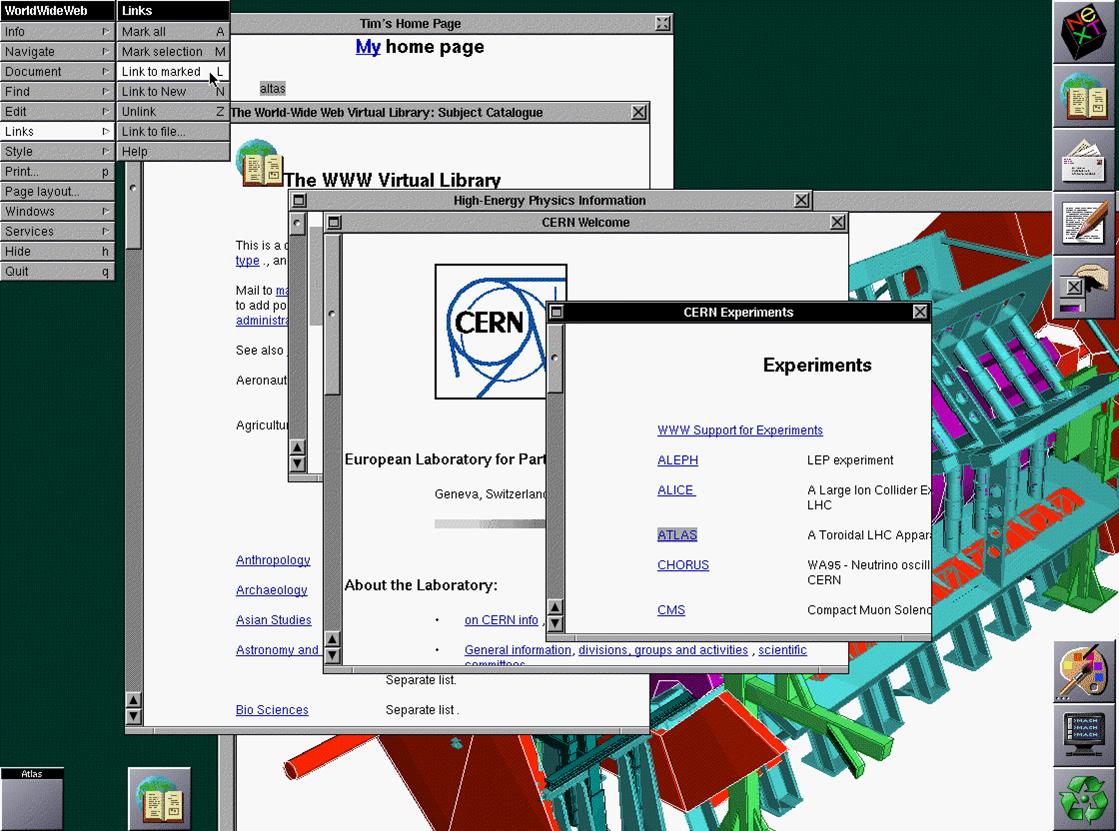
It’s all very well of course but how does this relate to the subject matter covered in this blog. Much of the R&D for the world wide web was done at CERN, culminating in the world’s first ever website in 1990 (pictured below – sorry I don’t have the source to credit other than CERN themselves).

For anyone worried about the end of the world happening when they switch on the experiment follow this link for reassurance http://www.hasthelhcdestroyedtheearth.com/.


Categories
Business ofcom voip

Number porting

Number porting has always been a hot topic in the telecoms world. Why does it take so long? Why can I move a number from “service provider A” to “service provider B” but not from “service provider C”.

In the “old” world porting was (is) an expensive process involving one provider actually forwarding calls to another. The number is never actually ported, just diverted. Whilst the consumer doesn’t see the costs the network operator certainly does.

Way back in November 2007 Ofcom decided to make it easier for everyone, consumers and networks alike and mandated that the UK telecommunications provider industry sort itself out. What’s more Ofcom gave everyone until 31st December 2008 to get a database populated with numbers so that porting would be made easy – within 2 hours for a mobile number, for example.

This would make switching service providers really easy and provide for a more competitive marketplace etc etc.

A working party was set up that includes all major telcos in the UK together with representation of smaller businesses via ITSPA (Internet Telephony Service Providers’ Association) and others. 

This activity seems to be making progress. Portco,  new company funded by industry to manage the porting process, is on the verge of being set up and a supplier/partner to build the database is near to being selected.

The initial requirement is for mobile numbers to be easily ported. Once the database is available the industry is being given until September 2009 to get it populated after which time mobile number porting should be a cinch.

Fixed numbers don’t have to be portable in the same way until the end of 2012 but I imagine that in reality it will happen a lot sooner because it is in the interest of everyone to make it happen.

Categories
Business ofcom voip

Emergency

Monday 8th of September is an important day for Internet Telephony Service Providers. This is the day by which they have to support Access to the Emergency Services by VoIP phone ie 999 must work when dialled.

There has been much debate amongst the global VoIP provider community as to how much regulation should be applied to VoIP. In the USA it centres largely on commercial issues. In other words telephone calls are taxed but VoIP calls were not taxed, at least initially. The argument was that VoIP calls are actually just computer to computer data traffic and not telephony as traditionally defined.

The incumbent telephony providers have fought hard to have VoIP  calls taxed in order to remove the competitive advantage notionally handed to VoIP companies.  Clearly it is in the interest of the VoIP provider community not to be subject to taxation. The justification for this is that it would stifle innovation amongst new market entrants. There is a case for this.

In the UK the argument is different. Regulation is not so much about taxation as personal safety. In this case Ofcom, the UK regulator, has mandated that if you provide telephony services that allow connection to and from traditional PSTN phone numbers you must provide access to the Emergency Services.

The Ofcom pronouncement comes with constraints including making sure that customers are aware that VoIP calls probably aren’t going to work if there is a power cut of if the broadband connection carrying the calls is down.

I am fully supportive of the Ofcom position.  What is going to be interesting is how the regulator responds to companies like Skype who at this time do not support 999 access and as far as I am aware have no plans to do so. Buyer beware.

Categories
End User security voip

Identity theft – Skype style

If your business uses Skype then you could do worse than check out all the cases of identity theft that have been occuring in the Skype user community. For those who don’t know Skype is a free PC based VoIP telephony service that also allows paid for calls in and out from the PSTN. It has always been tagged as an insecure service which potentially opens a corporate network to hacking.

Recently Skype users have been having their identities stolen, and their accounts being used to make illegal phone calls. What’s more if you periodically top up your Skype account using PayPal note that people have found their bank accounts being debited of funds to pay for someone else’s calls. This on it’s own is bad enough but the problem is compounded by the fact that you can’t ring up Skype to complain or get it sorted. Skype relies on email contact for support with apparently slow or non existent response.

What’s more your exposure as a business is exacerbated by the fact that in stealing your identity a Skype hijacker can also steal the business contacts you keep in your Skype account with who knows what consequences.

You can read more about the Skype problems on The Register and if you want to phone a VoIP service provider to discuss how to get a professional service call 08700 949600. 

Categories
broadband End User internet

How to Get Faster Broadband — Move to Spain

If you want to get faster broadband move to somewhere like Spain. Aha do I hear you say? Just the excuse you have been waiting for to make the move to a place in the sun? A bit drastic I’d say especially when I explain that the reason you might get faster broadband in Spain is because it almost certainly rains less there than in the good old UK.

It’s very interesting what snippets you pick up at Timico. Today, whilst gazing out the window at yet another downpour, I quizzed the tech support team as to whether there were any hot topics occupying their time. “Broadband” they responded. “We always get more broadband calls when it is raining”.

This took me somewhat by surprise but I checked it out and it is true. If you are a long way from your telephone exchange a bit of wind and rain can cause higher than normal noise on your copper cable, usually due to imperfect connections at the telegraph pole. That’s electrical noise – not something audible to mortals. It isn’t something easily diagnosed and ground based connections and leased lines do not suffer the same problem.

This noise can result in a temporary slowing of your broadband. Hence if you want faster broadband speed move somewhere where it doesn’t rain as much.

You heard it first on trefor.net.

PS if you do need tips on where to relocate the rain in Spain falls mainly in the plain.

Categories
Business internet

Ethernet circuits now cheaper than E1s

The market for Ethernet circuits really seems to be moving forward apace. It is now generally cheaper to put in a 10Mbps Ethernet leased line than a 2Mbps E1 although there is still an element of geographic dependancy in some cases. If, for example, your business is based in London then the pricing for Ethernet is becoming very aggressive. It is now possible to get a 10Mbps circuit in London for half the price of a 2Mbps line which is based on an older  technology.

The competition is such that it is now very much worth shopping around. As businesses depend more and more on the internet for their every day functioning then they are increasingly turning to leased lines. The usage doesn’t appear to be driven by any particular application or function. It is right across the patch.

Timico uses a number of major infrastructure partners some of who, at any given point in time, will have a good deal or offer on the go. It may well be the case that in order to provide the optimum price and technical tradeoff a network solution provided by Timico will have connections from a number of different network partners but which is transparent to the end customer.