This website is using a security service to protect itself from online attacks. The action you just performed triggered the security solution. There are several actions that could trigger this block including submitting a certain word or phrase, a SQL command or malformed data.
What can I do to resolve this?
You can email the site owner to let them know you were blocked. Please include what you were doing when this page came up and the Cloudflare Ray ID found at the bottom of this page.
Lucky Sir Michael Rake enjoys exclusive Hambleden broadband service.
Lovely piece reported by the BBC today, where British Telecom (BT) has admitted its chairman is the only person with broadband service in the village of Hambleden on the Oxfordshire-Buckinghamshire border.
BT said Sir Michael Rake’s broadband service connection was part of a trial of new technology. The village, they say, is too far from the exchange for a standard ADSL service.
The article doesn’t go into which technology was being trialled, but here’s a thought: BT could set up Sir Michael’s home as a POP and run tails from there. That way everyone in the village could get broadband service connectivity, and all would be happy. Sorted.
Spent this morning at the BT (Post Office) Tower in London being briefed about the plans for migration of old 20CN voice circuits to 21CN.
The BT Pathfinder Project has been running in two telephone exchanges in Cardiff since July 2008. Pathfinder is the test bed for running traditional voice services over BT’s 21CN network.
The current project has seen 75,000 POTS (Plain Old Telephony Service) circuits moved from their old Digital Local Exchange (DLE) connections to 21CN Multi Service Access Nodes (MSANs). The process isn’t straightforward.
In the first instance BT has had to conduct large scale testing (£150m worth) on hundreds of different bits of customer premises equipment that connect to phone lines – phone systems, alarm systems etc.
Kit that doesn’t work on MSANs has to be identified so that customer lines that have this kit plugged in at the other end do not get migrated to 21CN. The rule of thumb is apparently that 10% of exchange lines will not be migrated to 21CN because of it.
The trial has been slow going. The pace is being stepped up with a further 275,000 lines planned for migration between June 2010 and January 2011. This will give BT the experience of switching over whole telephone exchanges in one go.
The next step will then be to extend the trial to the migration of ISDN circuits as well as POTS in the Thamesmead and Redditch areas. There are no timescales for this at the moment.
Why so slow you ask? Due to economic circumstances BT has taken a strategic decision to delay the full implementation of 21CN until 2020! I guess I can understand this especially when you consider that the migration will offer no perceived benefit to the customer. A phone line on 21CN will look identical to one on 20CN.
The delay in spending the money on the rollout does come with risks. What BT doesn’t know is when the current estate of SystemX and AXE10 exchanges will start becoming unreliable. Electronic equipment follows what is known as the bathtub curve of reliability. If a bit of kit is going to fail it does so either early on in its deployment or after a very long time in use.
The carrier is watching its reliability statistics on a month by month basis to check for signs of the network climbing the sides of the bath again.
If this starts to happen then BT can rush through a programme of exchange migrations – hence the Pathfinder Project. There is a scenario where specific exchanges could be moved over to 21CN in order to provide spares for the rest of the 20CN network.
In the meantime we will be getting in touch with customers in the Cardiff area to let them know what’s coming and to check out their equipment compatibility.
Readers should not get the wrong idea about 21CN. There are plenty of services that are based on it – ADSL2+, FTTC,FTTP, EFM, metro Ethernet to name but a few – you will have to Google the acronyms if you don’t know what they stand for. The mobile networks are also apparently using the 21CN infrastructure for backhaul to the tune of £750m a year.
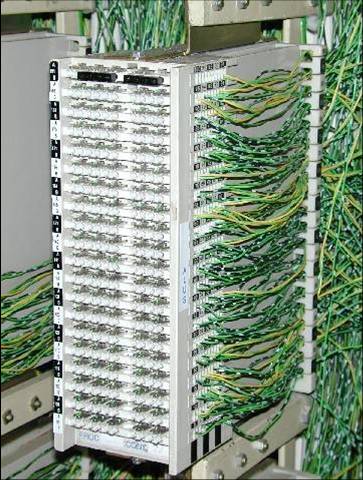
Because I know you’re interested the photo below is of a JT47 Transfer Connection Point (TCP) Shoe used to make bulk migrations to 21CN voice easier in the exchange 🙂 .
As the title says Timico has been recognised as one of the 25 fastest growing technology companies in Europe. Wahey.
This is according to Deloitte who base their calculations on five years compound annual growth (5,055% in our case). This nicely complements our 7th place in their UK rankings and the third appearance on the trot in the upper echelons of the Sunday Times Microsoft Techtrack 100.
I note that three carriers have launched a wholesale IPVPN proposition. BT, Cable and Wireless and Opal have all opened up for business into the reseller channel. This really does reflect the growing opportunity in this space brought on by lower cost IP connectivity and greater use of internet/cloud based services.
Timico has been offering such MPLS based services for almost five years. We call them Private Wide Area Networks (PWANs). This year the number of Ethernet leased lines we will have installed for customers looks like being 50% as many as we did in the first five years and next year the way things are going I expect the estate to double.
When we started to offer PWANs in the market there were very few ISPs doing it. This was partly because the vast majority of ISPs had low bandwidth 34Mbps central pipes that did not support L2TP, a practical necessity for the provision of MPLS PWANs. Many still don’t have the technical knowhow even if they have the right connectivity and it is quite common for small ISPs to resell another’s IPVPN and claim it as their own.
This announcement from these 3 carriers effectively creates a dividing line between the haves and the have nots. Those who can build their own networks and those that just resell others’. None of these “builders” has the reach to provide a network that is exclusively their own. They all buy tails from BT Openreach for the many locations in the UK outside their own network footprints.
Our own approach is not to offer wholesale connectivity. We want to build up the Timico brand in the business end user community. We do operate our own MPLS network though and I see this as being of strategic importance in building the successful Communications Service Provider for the business market of the future.
As usage of the internet grows it has of course totally changed the way people interact. It seems as if I sometimes don’t see my seventeen year old, Tom for days on end but it doesn’t stop me communication with him. We just chat on Facebook.
The image this portrays is of online addicts (of which I confess I am one) buried in their PCs for hours on end ignoring everyone else in the house.
This might well be an unfortunate by product of the internet age. I do however think that this is a phase we are just going through. As technology improves it will give us more control over our lives and allow us to start living again.
This is very much likely to be the case in what might today be called a dormitory village. Most people in these places commute long distances, buy their groceries from superstores on their way home (or online) and village life becomes an impoverished cousin of its glorious social past.
In the future the internet will take away the need for these people to commute, for at least some of the time. The efficiencies that will come will give people time to physically reconnect with others in their local environment and village life will come again. Maybe the village shop and Post Office will reopen!?
In the meantime I have to clean my rose tinted spectacles, get back to my 16 hour day and someone somewhere needs to get around to putting fibre into that village.
PS Tom does occasionally update his photo on Facebook so I do keep up with what he looks like as well. Kids change so quickly don’t they? 🙂
The Alliance Against IP Theft held a meeting yesterday at Westminster Hall in The House of Commons. Present were 5 speakers from the creative industries – from Fulham FC, Universal Music, a freelance writer and journalist, a publisher from Random House and a construction manager at a film studio – and a panel of MPs including Tom Watson, John Whittingdale, Kerry McCarthy, Lord Corbett and Steven Pound. The meeting was chaired by Janet Anderson who leads the All Party IP Group.
Each speaker gave a talk on how piracy was having a negative impact on things like investing in new talent. The MPs then asked a series of questions.
Most vocal was Tom Watson who argued that to give the Secretary of State unrestricted power to make rulings on copyright in the future was actually a potential problem for rights holders – MPs would be concerned that a Bill was trying to give powers to the Secretary of State without parliamentary oversight.
Mr Watson also questioned the figures that rights holders produced that suggested that every unlawful download was a lost sale. The panel agreed with him when he said that the creative industries had never been in a healthier state in terms of popularity, despite filesharing.
Lord Corbett gave an indication of how the Bill will progress through the Lords – it will receive its Second Reading next Wednesday December 2nd and is likely to leave the Lords and enter the Commons by the end of January. With a two week half term break in February, it was suggested that as Parliament is rumoured to be dissolved at the end of March for the general election, there was a good chance that the Bill will run out of time.
This is clearly an important phase where lobbying for and against this Bill is going on. It is the first time I have been involved at such close quarters in something so important – one that is generating high emotion from both sides. The strange reality is that I doubt that there is a single person who is against the proposed regulation on P2P filesharing who actually supports the illegal activity. It is just that they don’t think this regulation is the right way to go about it.
Also I’m not a particularly political person but it does strike me that we should now just get on with a General Election because we are now entering a silly season where there is a danger that Laws will be rushed in without properly being thought through. Of course I know politics doesn’t work like that…
I don’t always agree with Andrew Heaney of Talk Talk but on this occasion he is spot on. He has distributed a link to a petition at Number 10 Downing Street which reads as follows:
‘We the undersigned petition the Prime Minister to abolish the proposed law that will see alleged illegal filesharers disconnected from their broadband connections, without a fair trial.’
The link to the petition is to be found here. I’ve already signed up. There are currently 15,939 signatures but this is early days. Make your voice heard.
PS Less than 1 hour later it is up to 16,991 signatures.
Now that the Digital Economy Bill has been published we can comment on its specifics. and in particular on the aspects relating to what the Government describes as “Online infringement of copyright” or illegal filesharing/Music Piracy in every day language. It doesn’t just pertain to music, it includes movies and software as well – many of the abuse notices received by Timico in respect of naughty customers are concerned with the latter.
First of all the proposed Bill grants Lord Mandelson far too much control. The Secretary of State will have the power to make specific recommendations on costs and impose an obligations on ISPs to use technical sanctions. The uninitiated should read this as “telling ISPs how much they will be allowed to charge rights holders for the implementation of the requirements of the Bill. Technical sanctions = cutting off broadband connections.
In the first instance the industry thinks these responsibilites should be given to an independant body. Also the idea that ISPs should share some of the cost burden is contrary to the Government’s own legislation – the Regulation of Investigatory Powers Act (2000) (RIPA) – which considers it appropriate for ISPs to be reimbursed for costs incurred when assisting in serious criminal investigations, such as terrorism or kidnap.
What the Government is saying here that it believes that it is ok to recover costs for assistance with the pursuit of serious criminals but not for costs incurred pursuing an alleged civil infringement on behalf of a commercial interest. A scenario that normally burdens the party with the commercial interest with the cost.
ISPs are happy to help and indeed are not in favour of copyright infringement but think it is grossly unfair that they have to pay to police it.
Secondly the suspension of users’ accounts as a potential sanction is wholly disproportionate and is in direct opposition to the objectives outlined in Digital Britain to increase online participation. It seems that this will enable the suspension of users’ accounts without a ruling from a judge. This is potentially in defiance of the forthcoming EU Telecoms Package that guarantees users’ rights to a presumption of innocence until proved guilty.
The Government seems to be blind to the fact that serious copyright infringers can easily evade detection by employing encrypted P2P (for example).
Instead of wielding a big stick Government should be asking rightsholders to reform the licensing framework so that legal content can be distributed online to consumers in a way that they are clearly demanding. Currently the online copyright law is a mess spread across many countries and legislatures and the costs to industry of getting it sorted are huge.
The Government is trying to push this Bill through quickly but it isn’t going to stop the problem. Lift up your heads and raise your voices all!
Now that the Digital Economy Bill has been published we can comment on its specifics. and in particular on the aspects relating to what the Government describes as “Online infringement of copyright” or illegal filesharing/Music Piracy in every day language. It doesn’t just pertain to music, it includes movies and software as well – many of the abuse notices received by Timico in respect of naughty customers are concerned with the latter.
First of all the proposed Bill grants Lord Mandelson far too much control. The Secretary of State will have the power to make specific recommendations on costs and impose an obligations on ISPs to use technical sanctions. The uninitiated should read this as “telling ISPs how much they will be allowed to charge rights holders for the implementation of the requirements of the Bill. Technical sanctions = cutting off broadband connections.
In the first instance the industry thinks these responsibilites should be given to an independant body. Also the idea that ISPs should share some of the cost burden is contrary to the Government’s own legislation – the Regulation of Investigatory Powers Act (2000) (RIPA) – which considers it appropriate for ISPs to be reimbursed for costs incurred when assisting in serious criminal investigations, such as terrorism or kidnap.
What the Government is saying here that it believes that it is ok to recover costs for assistance with the pursuit of serious criminals but not for costs incurred pursuing an alleged civil infringement on behalf of a commercial interest. A scenario that normally burdens the party with the commercial interest with the cost.
ISPs are happy to help and indeed are not in favour of copyright infringement but think it is grossly unfair that they have to pay to police it.
Secondly the suspension of users’ accounts as a potential sanction is wholly disproportionate and is in direct opposition to the objectives outlined in Digital Britain to increase online participation. It seems that this will enable the suspension of users’ accounts without a ruling from a judge. This is potentially in defiance of the forthcoming EU Telecoms Package that guarantees users’ rights to a presumption of innocence until proved guilty.
The Government seems to be blind to the fact that serious copyright infringers can easily evade detection by employing encrypted P2P (for example).
Instead of wielding a big stick Government should be asking rightsholders to reform the licensing framework so that legal content can be distributed online to consumers in a way that they are clearly demanding. Currently the online copyright law is a mess spread across many countries and legislatures and the costs to industry of getting it sorted are huge.
The Government is trying to push this Bill through quickly but it isn’t going to stop the problem. Lift up your heads and raise your voices all!
It’s out, after the first reading in the Lords yesterday! The Digital Britain bill that is, now known as the Digital Economy Bill.
After months of debate, lobbying and speculation the proposed detail has been published and at first sight it appears to have bits missing. Of interest to ISPs is that there is a lot of content pertaining to Copyright of online digital content – ie illegal P2P filesharing but nothing regarding the Universal Service Obligation for broadband.
There is clearly some political manouvering going on here. The 50pence tax is already supposedly going to be in the Finance Bill. Word is that the Government doesn’t think that the USO specifically needs to be in any legislation as it will either be covered by the Finance Bill or the money is already there from the Digital Surplus – the fund set aside to help with Digital TV switchover.
By doing this the Government is trying to increase the likelihood of some of the Digital Britain Review becoming law by splitting it up into smaller bits. It is also quite possibly using this to brush under the table that they are going to struggle with the implementation of an USO. They just can’t get their brains round the problem. It is very unfortunate for the millions of Digitally Excluded unfortunates around the UK in suburbs and rural communities alike. I might be wrong about this but I don’t think so.
Also of interest are proposed powers that will allow the Goverment to take over management of Domain Name Registry Nominet if it doesn’t like how it is being run. Nominet has seen some board room action this year with a couple of Directors making a lot of noise over governance. The issue is fairly compicated but I believe that one of the issues was the amount of surplus cash being generated by the not for profit organisation.
Details of the Bill can be found here. Separate post on copyright comes next.
Spanish Minister of Industry, Tourism and Trade Miguel Sebastian has just announced that 1Mbps broadband will be a legal right in Spain by January 1st 2011. Apparently 4 million people in Spain cannot get 1Mbps today.
What’s more they are putting up 400M Euros to help with this. Whether this is enough is in my mind neither here nor there. Also I don’t know how solid this is – the UK Government also made bold statements with Digital Britain that have become more confused and wishy washy as more people get involved.
Here in the UK we now await tomorrow’s Queen’s Speech to tell us exactly what we will be in for. It already seems that the 50 pence broadband tax is not going to be part of it or at least this is deferred to a Finance Bill that is unlikely to see the light of the Royal Seal.
Years ago when I worked for Mitel there was a story that a politician running for election as Prime Minister of Ontario ran on a manifesto of getting rid of speed cameras. Apparently he won with a large majority.
Here’s a tip for those running in the next UK General Election. Promise Next Gen broadband for all by 2012. It a guaranteed election winner and the cost is also neither here nor there.
PS the link is to a Spanish online service – I used Google Translate to read it – it is brilliant.
Following on from the Jeff Pulver #140 Conference in London yesterday I’ve been trying out a new toy.
This is the Zi8 HD digital video camera by Kodak and I have to tell you it is a stunner. Presented to me yesterday by Jeffrey Hayzlett, CMO of Kodak the HD video quality is outstanding and it is extremely easy to use.
My kids have already latched onto it and started playing with it though rapid adoption by children is not necessarily a pointer to how easy a gadget is to use – technology comes naturally to them.
The camera facia comes printed with the YouTube and Facebook logos, which is a strong enough hint for even the dumbest of users.
I’m not going to bore you with the camera spec. What I will says is that the 75MB of the 59 second video below is well within the 2GByte allowance that YouTube gives for a single video!
The video is presented below for all to see. It’s no professional production and I note that I should have combed my hair first – I’m desperate for a haircut. That’s showbiz folks.
The Zi8 is groundbreaking and although I’m no expert I have no hesitation in recommending it after just a short test.
You may have noticed that this blog doesn’t major on gadget reviews. The point here is that this another contributor to the growth in bandwidth usage as people start to upload more and more HD footage to sites such as YouTube. What goes up once of course gets downloaded many times, assuming it is any good. It’s a worry for those of us having to manage ADSL backhaul bandwidth but that’s progress for you.
Today I’m with Jeff Pulver at his #140 conference at the O2 Indigo. Jeff originally (not that long ago actually so to use the word originally seems a little strange) started the #140conferences in February as a vehicle to capitalise on the Twitter revolution.
Very quickly the theme of the conference has moved on to real time communications, rather than Twitter specifically although Twitter is still mentioned in every other sentence by every speaker.
Sitting here listening to the talks what strikes me is the complete diversity of people appearing on the stage – ranging from international media stars (ie Stephen Fry) the Chief Marketing Officer of Kodak, a farmer, an off license owner, a teacher, and a policeman to name but a few. Big business is here and so is small business
I’m not going to dwell on specific talks, although Stephen Fry interestingly uses the example of the invention of the printing press to compare with what is happening now on the internet with Twitter. I’m sure he pinched it from me because that is what I use for my new starter induction talk at Timico 🙂
Notably Kodak also ran a competition to name a new camera on Twitter. It was a fast way of running a focus group with a huge number of people.
The biggest take away for me so far is the use of the word “authenticity”. There is so much rubbish out there on the internet (Twitter, Facebook, blogland, everywhere) that you have to really have something to say to make an impact. Just rehashing other people’s stuff isn’t good enough, although I am always grateful for “retweets”.
Being ruthless I have on occasion “defriended” people who indulge in uninteresting status updates. I’m sure people have done the same with me – you have to be able to take the rough with the smooth.
A milestone for the London Internet Exchange with its 15th birthday meeting today at Goodenough College in London. These are seriously useful meetings of like minded souls from the internet industry.
The internet is run by geeks that work extremely hard. In fact they live and breathe technology on a 24 x 7 x 365 ¼ basis and these LINX meetings bring them together for long days of meetings and presentations but also long evenings of letting their hair down.
LINX meetings are quarterly. Since the last one in the summer the peak traffic on the LINX network has grown by an incredible 25%. If the trend continued that would mean more than doubling in a year. The traditional perceived wisdom for growth in internet usage is 50% pa which is close to what I see on the Timico ADSL network.
LINX’s growth has been fuelled by an increase in membership of around 15% this year though clearly that wouldn’t account for the proportional increase in bandwidth.
For geeks everywhere who believe that size does matters the LINX network currently has over 2.5Terrabit per second capacity. The organisation is clearly providing value for money which is why all these new members are knocking on the door.
A year ago I seem to remember a statistic that said that 65% of the internet was reachable via LINX peering. Now this has grown to 70%. This is good news for end users as it helps to keep prices down.
Interestingly 75% of new members are from outside the UK, including a fair number from Russia. The UK is becoming increasingly an important place on the internet map.
More snippets from LINX67 as I think of them. The meeting is absolutely packed.
I noticed over the weekend that the exhaustion counter for IPv4 dropped below 400m addresses. This is just a stake in the ground. As I write there are 653 days to go. I’ll revisit this when it drops below 300m.
The cats and dogs rained merrily upon the good citizens of the UK on Friday and Saturday, and in consequence the number of problems with phone lines and broadband shot up. I don’t have the definitive numbers to hand as I write this as I am headed southbound on the train, but anecdotally we probably saw double the number of faults being reported compared with a normal Saturday.
These would have been for phone lines and broadband, though I know from experience in driving home through a cloudburst that mobile services also degrade during really bad weather. Roll on Fibre to the Premises, I say.
I try and keep the content of this blog varied. One of the nice things about my job is that I am able to do this.
One of the recurring themes though relates to regulation. As a board member of the ISP Association I get a lot of visibility of things going on here. In fact a huge amount of the value that ISPA provides to the industry lies in the fact that the it does so much work in this area – thus removing the need for all ISPs to be expert.
It is undeniable however that the regulatory pressure on ISPs is increasing and at some point this is going to start having a serious effect. This week alone the subjects being discussed in Parliament include the Intercept Modernisation Programme (Big Brother is watching you), Music Piracy, website filtering under the Terrorism Act and Safety Online. I am afraid that in the medium to long term the cost of all this regulation (or proposed regulation) is going to mean that only larger ISPs can cope with it.
The industry is already struggling with the network upgrade costs associated with increased use of the internet (iPlayer,SkyPlayer, interactive gaming etc etc). A small ISP with perhaps only two or three thousand customers – and there are many of these – can’t afford the capital expense associated with this. Timico has already made three acquisitions of such ISPs.
Not everybody is fortunate to have the same private equity support and ambition as Timico and I predict that within the next five years the number of UK ISPs will shrink significantly, perhaps to fewer than 50 (from maybe 300 today). I see this as a real business opportunity because in actual fact the market is going to grow. It is just that the barrier to entry will get higher.
Did you know that a state of the art supercomputer costs $100m? The price never comes down with time – the speed just goes up. Today’s leading edge box — actually it’s a datacentre full of racks, not a single box — has over 1Petaflops of processing power.
Such is the progress of technology that in three years time this will not even be in the top 500 of supercomputer performances. At that point the maintenance costs also start to ramp up so your average supercomputer owner just bins it and buys another one. It’s what I’d do 🙂
What is also interesting is that today’s supercomputer processor speed flows down to the laptop of 12 years hence. So in 2021 you will get one hell of a bang for your buck. Whether you will need that much power to send emails and operate Word 2021 (or whatever it will be called then) is unlikely.
I guess the power will be usable for improved 3D HD graphics for gaming and TV but I’m not sure what other apps will need it. Whole brain simulations on a laptop perhaps. Build it and they will come… It does point to a huge continued growth in network bandwidth usage.
Of course the laptop won’t cost $100m. I just put that in for effect! My guess is that all laptops will come free with subscription to network services.
Pillaging mobile broadband service gold, they are!
Last night I met someone at the Engineering Dinner at Bangor University who put a different slant on the Digital Divide.
Stephen Yates lives on a small-holding just outside Holyhead on the Anglesey coast. Although only a three mile walk from his nearest pub in Holyhead he can’t get broadband service – the copper winds its way around the lanes and by the time it gets to his place the speed has slowed to an unusable dribble.
Interestingly, he does get a very fast mobile internet connection but only when there are no ferries passing by. This puzzled me at first. Is the steel side of the ship having an effect on the signal strength? Actually no. Whenever a ferry comes into sight of Holyhead everyone on board starts using their mobile phones and all of a sudden instead of having the base station practically all to himself the cell is shared with the incoming hordes.
In the old days these incoming hordes were called Vikings, pillaging gold on their way around the Irish Sea. In modern times they just pillage the mobile broadband service bandwidth.
Attended a meeting of Bangor University Industrial Panel today. I am pleased to say that undergraduate intake is up on the previous year which was itself up on 2007. Moreover all places were filled well in advance. This is I’m sure helped by two factors.
The first is that Bangor’s School of Engineering is ranked second in the UK according to the 2008 Research Assessment Exercise.
Secondly when students are graduating with debts of £20,000 they are increasingly looking for value for money in the degrees that they take, particularly during these recessionary hard times. An Engineering Degree from Bangor is not an easy option but a valuable one once attained.
An University faces challenges remarkably similar to industry. One of these is to provide products, in this case course material, relevant to the employment market place that their graduates will face. This is of course where the Industrial Panel can add value and I feel honoured to be invited to contribute.
The irony is that the meeting today was held in the library of the Engineering building. Somewhere I hardly visited as a reprobate undergraduate 🙂 (Only kidding…?)
I woke up this morning (there’s a song there…) to the news from the Daily Telegraph that ” Government announced yesterday it was pressing ahead with privately-held “Big Brother” databases”. This is the Interception Modernisation Programme that has periodically been in the news this year with general opposition and a subject I have posted on in the past. It would indeed have given the ISP industry a headache.
I now hear a contrary position from the Guardian which tells me “Legislation to access public’s texts and emails put on hold. Widespread concern about the safety and security of communications data prompts Home Office rethink.”
My understanding is that it is the Guardian that is right on this occasion and that the Telegraph has tapped into the wrong wires. I imagine that the Labour party has enough on its plate in the run up to an election without further alienating the voters.
“When they woke up this morning someone got their wires crossed and my head it felt confused, oh yeah. ” I think that’s what I was trying to say 🙂
I just put one of my kids to bed via Facebook. He had already been sent up to his room but I could see that he was still online – almost certainly using the wifi connection on his iPod touch.
The IM conversation went like this:
Tref oy
Tref bed!
Joe ok
Tref goodnight
Joe is offline
I know that the cynical amongst you will decry this as poor parenting but pshaw I say. It is modern life – location independent fatherhood. There is still, however, no replacement for a real cuddle which is dispensed regardless of the age and sensitivities of the offspring.
It’s a fair bet that most punters enthusiastically ringing in to cast their votes on popular game shows don’t think about the network capacity problems they are creating! Typical Joe Public eh?
When someone dials in to one of these shows they make use of Media Servers in the telecommunications network. Typically Media Servers are boxes especially designed for a single purpose. There are a number of such types of server used by Telcos (and I count Timico amongst them) for specialist applications such as the aforementioned IVR based voting system and business services such as conference bridges.
The problem is that the kit used for voting is different to the kit used for conference calls and meetings. This means that expensive bits of kit lie idle in a network for much of the time. Conference bridges are used during working hours and TV Game Shows are on in the evenings (apparently 🙂 ). The surges in network demand prompted by game shows also results in sometimes between 10 and 100 times overprovisioning of capacity compared to the average state of affairs which exacerbates the costliness!
This is all about to change – watch out for the virtual network!
On Friday I met with Chris Boulton of NS Technologies at the Celtic Manor Resort in Newport. Chris used to work in the Office of the CTO at Ubiquity Software, a Terry Matthews SIP company that was bought by Avaya couple of years or so ago and has a blue chip heritage in designing advanced IP communications networks infrastructure.
Chis is currently working on the Media Resource Broker. We are all used to the idea of running different applications on a PC or handheld device, or even games on a gaming box. Telecoms networks though have always been built using dedicated kit. The MRB changes this by allowing telcos to build networks that use standard platforms targetable at different applications according to demand at any given time.
So a box that is used as a conference bridge in the day can be used for voting out contestants in the evening. This will not only save huge amounts of money but also result in a flexible and scalable network architecture that can then quickly be applied to other functions, many of which will not even have been thought of yet.
We talk about doing things in the cloud but it is interesting to see that even infrastructure is moving in this direction.
The whole world is moving towards becoming virtualised. I can even see the day when the typical household will have a box under the stairs next to the gas and electricity meter that will be its network processing resource. This will bring with it huge opportunities in business.
It will also of course heighten our reliance on such resources and the Domesday scenario of when it all goes wrong becomes even more of an issue. But there again even that represents an opportunity…
Had a day or two to play with the wave. Some of my Facebook friends have already commented that it is no good without others to communicate with. At this time I have two friends in my wave contacts list :Luc from Google who invited me and Cyberdoyle.
This fits into the category of sad git with no friends. However Cyberdoyle, who is the most advanced farmer’s wife (for I believe such is she) in the world when it comes to the internet, is showing me the way. Cyberdoyle is hugely knowledgeable when it comes to Rural Broadband (or lack of) and the Digital Divide. Martha Lane Fox should recruit her.
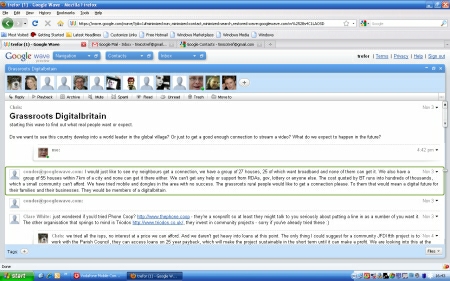
Cyberdoyle, ok Chris, started a wave and showed me the way. Pic below:
Grassroots Digitalbritain wave
There are currently 14 people catching the wave, none of who I know other than Chris. The resolution of the jpeg doesn’t do it justice. However what you are seeing is a multimedia collaboration work in action. This could be a cross departmental business tool, a group of friends planning a party or something online usable by any community anywhere (except where you can’t get broadband!)
This is impressive and I’ll keep you posted on progress with the Grassroots Digitalbritain wave which you might or might not have gleaned is all about a community of people trying to get the internet into their lives. I get this image of an inner city council estate where the residents are trying to make life better by raising money for a community centre. There is no difference between them and rural communities wanting to access the internet.
Anyway Google Wave – so far so good. Thanks Luc for inviting me and who needs lots of friends when you have Cyberdoyle.
Had a meeting with BIS this morning as the final opportunity to influence the forthcoming Digital Britain bill. Nothing was said really that hasn’t already been published somewhere. We will know the precise content in a couple of weeks.
There is an awful lot of detail that will have to be worked out and with only around 5 months or so until the notional date of the General Election there is, apart from the increasingly vociferous opposition from the ISP industry, a concern that the time available is not enough to properly consider the bill.
Notwithstanding all that ISPs will have to start working very hard to make sure that all MPs fully understand the issues being debated/proposed here.
This includes Members of the House of Lords which of course introduces a whole new set of issues. What will their Lordships think of a Bill with a major tenet being Peer to Peer Piracy? It is just not the done thing old chap. The Upper House works on a strong basis of trust 🙂 . Seriously though the bill will have to go through the Lords and their Lordships are likely to be closely examining the privacy / consumer rights aspects of the legislation
Notwithstanding that bit of fun I thought it worth adding a few educational points to the debate at this late stage.
Firstly serious P2P illegal downloaders will just move to on to private encrypted networks/Newsgroups that hide your underlying network address and so make it hard to track you down. These do charge which might make it unattractive for Music Pirates wanting freebies. These sites are also unfortunately apparently often attract child pornographers and other lowlife.
If you don’t know anything about them check out the links below:
There is also a continued stream of information suggesting that those that do indulge in Music Piracy also spend more money than those that don’t. Check out the latest market research here.
I’m looking for a VoIP network engineer to join our expanding VoIP team. The job entails assisting with the running of our Nortel A2E SIP platform, the development of new services, interoperability testing with vendors and other service providers, 3rd line support and, I’m sure, a plethora of other interesting and challenging tasks as we think of them.
VoIP is an important string to the communications bow these days. Timico is a VoIP operator rather than a White Label service provider reselling soneone else’s proposition. We probably don’t lead with VoIP in a large percentage of deals but the ability to provide VoIP services is becoming an important part of winning corporate Wide Area Network business.
For example it is fairly typical for a company to outsource the management of a few hundred sites’ connectivity to us. They will then take advantage of the fact that they now have an MPLS network and run VoIP between sites and to all their homeworkers.
If you want to join a company that is going placesdrop me a line with your CV or take a look at the Timico website.
PS it is always a risk posting a job ad on the blog – I get inundated with calls and emails from recruitment organisations! It is the cheapest way to advertise though. Please retweet 🙂
I’ve been thinking about clouds. It’s a very trendy thing to do at the moment. It’s something you notice about trade shows. A trade show will evolve its name in line with what the organisers think will bring in the punters.
For example in the UK “VoIP for Business” became “VoIP for Business incorporating Unified Communications” which then became “Unified Communications”. I fully expect Unified Communications to morph into “Unified Communications with cloudy bits”. It will probably be the same underlying list of exhibitors.
Anyway the popularity of the cloud buzzword is of course because the world is moving into the cloud. The cloud is still for most an ethereal place that is difficult to get the grey matter around. It appears on the advertising copy of so many vendors how do you decide how to take advantage of it. This is the case whether you are an end user, a business or a potential provider of cloud services.
Consumers will use a few branded services such as Google, Microsoft, Amazon etc. Business however needs something different, even it is just a better service level. So at the moment I think the business world is manoeuvring to understand how the bits of the fluffy jigsaw fit together.
They will end up dealing with specialist cloud integrators. This will provide the differentiation and some clouds will definitely stand out as being better than others.
As it stands you need to be able to keep your feet on the ground and head just above the clouds so that you can look around and see where these better clouds are starting to form 🙂
Very enjoyable chat with Neil McArthur, Chairman of Talk Talk Technology Group. Neil was one of the original team at Opal before they were bought by Carphone Warehouse and is the architect of the CPW Next Gen network.
I was very impressed with their broadband technology network, a dual 400Gig ring that comes with all the MPLS bells and whistles. I have to say that having seen it they have the potential to be a real force to be reckoned with.
They have come from a long way behind the incumbent and have made great strides from the days of the launch of the CPW LLU play, six months or so before it was actually ready.
They could potentially, given a level playing field with BT Openreach, become a real competitor to BT Wholesale. My position up until now has been that the only game in town is going to be BT with potentially a broadband technology competitor made up of Virgin and ANO.
It makes me think that the complete spin off of BT Openreach from the parent Group is essential to ensure this level playing field. The regulator could concentrate on ensuring fair play the local loop and let the battle happen at the wholesale network level, in the business market at least. It does make me suspicious of BT’s efforts to keep Openreach in house.